
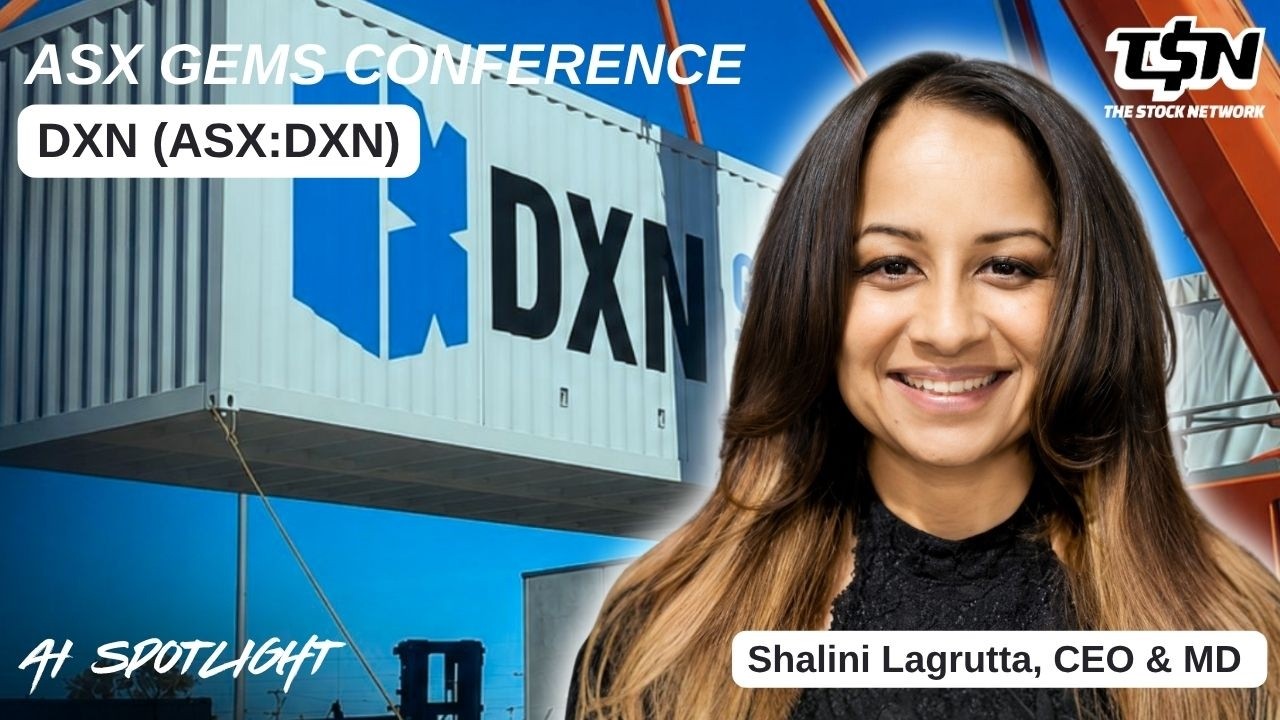
Transcription of The Stock Network Interview with 4DMedical (ASX:4DX), Managing Director Shalini Lagrutta
Shalini Lagrutta: AI is rapidly changing the global data center landscape, creating demand for high-performance computing infrastructure that can be deployed faster, scaled efficiently, and delivered closer to where power and connectivity are available. DXM’s share price has risen more than 2,000% in the last three months, and its fabricated modular data center solutions are positioned to participate in this growing market. With AI, HPC projects providing an early entry point into what could become a much larger infrastructure opportunity.
I’m joined today by DXM’s Managing Director, Shalini Lagrata, to discuss the future of AI infrastructure, how data centers are evolving to meet AI demand, and where DXM sees its biggest opportunities. Shalini, welcome to the Stock Network. Thank you, Lel.
Thank you for having me. Now, how is the rapid growth of AI changing the way that data centers need to be designed, built, and deployed? And also, to what extent do you think infrastructure itself has become the deciding factor in how fast AI can grow? Yes, it is the number one, I suppose, restriction that everyone is facing today is how fast. So that in the past, it was the technology itself.
But today, what we’re starting to see is the biggest, I suppose, moving factor for deployment of infrastructure is how quickly can you grow. So it is the speed of tokens. That’s the terminology that I’ve heard used a few times now in the last few weeks.
So it’s about how quickly can you have tokens available for infrastructure build. And that is the key reason why DXM exists. It is about building a solution that customers and our clients are looking at in terms of speed of deployment, besides the usual infrastructure quality and being able to be fit for purpose.
And all of that is assumed. But the difference now is the modular prefab infrastructure allows for it to be a speed product in addition to everything else that’s needed to be there by default. Yes.
And if we can look closer at the case, really, for modular infrastructure, can you explain why does prefabrication and modular solutions become increasingly important as AI companies really look to deploy that high-performance computing capacity faster and also in new locations? Yes. So it is because of the way AI works. So if you sort of look back in history, we had multiple revolutions in terms of development of digital infrastructure.
So the mobile network was a major turning point where networks started becoming a lot more digital and the demand was significant. So mobile penetration, internet, high-speed internet penetration, these were all key milestones. Demand has always been there.
So the network and the deployment needs that. So if you sort of look at how people have always deployed infrastructure, it’s always been on-prem, on-site. And then slowly, what then happened is telecom networks started evolving into data center networks because you’re carrying data as opposed to just telecom connectivity.
So now you’ve got this data infrastructure that has predominantly been there. You’ve got the advent of real estate infrastructure trusts that are now investing in data centers. And on comes AI.
So AI is the next phase where the compute power is now substantially increased. And you’ve got various chipsets that is allowing for this high-speed compute. And so what you’re starting to see is that everybody, not just the data center companies, not just the telecom companies, you’ve got new cloud operators, you have real estate and developers, people who have the basics of land power and off-takers looking at building AI infrastructure.
And it is very possible to do that. And the demand for it is substantial. And so you’ve got this entire merge of multiple reasons added to the fact that you have, you know, we had COVID historically.
So in the last six years, the way that work has changed, people work remotely, all of a sudden you have got this, you know, sort of series of events that has pushed everybody to look at this and go, we can’t build the same way we’ve always built, which is having a whole lot of people on-prem, on-site building. And the capability and the skills of these people are limited. Like you can’t spread them in across multiple gigawatts that is being built around the world.
So everyone’s looking at prefab now. So it’s not just our customers, our, you know, sort of our partners. If you think of even the vendor world are all looking at how can we actually build this off-site and bring it on-site.
So this is the only way you can actually meet the demand in any way. And what’s interesting is that if you sort of look at the cross section of the globe at some data center companies have always adopted some level of prefabrication, some not so much. So, but everyone now is forced to look at it for all the reasons I mentioned.
Yes. And Shalini, if we can finally look at the opportunity ahead, what does DXN need to do really in order to capitalize on the growing demand for AI infrastructure? And also, do you see this becoming a larger share of your identified pipeline, which last disclosed showed a 21% leverage to AI infrastructure? Yeah. So there’s a couple of things we need to be doing because we have started developing modular data centers for many years.
So myself and my CTO historically, we’ve worked in different companies that were already doing this, not necessary for AI infrastructure. We’re talking about cable landing stations, subsea industry, satellite industry. The economics and the concept of what we do is already ingrained in our DNA.
That’s already, so we start with the end in mind. We start with the design, the engineering, the know-how, we pull together the vendors, the supply chain and complete the full integration for a customer solution. But at the same time, the factory, our factories are on standby for the long lead items.
We’re starting to build modular solutions as we complete the design so that you’re sort of merging a timeline for a customer, which is, as I said, when we started, which is the product is a speed to market. Every one of our customers have that as a basis and we’ve got to start at an end date and that’s how we’ve always worked. So now with AI, how we would scale is essentially replicate and duplicate what we’ve got multiple times.
So today we’ve got a facility in Perth manufacturing. We’ve already got facilities ready in the East Coast, in Australia. We’ve already got, and we’ve been sort of planning this and working this the past year and a half.
It’s not sort of overnight. We kind of know that this is coming. Malaysia, Johor Bahru, which is across the causeway, we’ve got another facility.
Now bear in mind, these are capital light factories. They’re not, you know, we’re not buying the facility. What we’re doing is we are replicating what we’ve got, the concept we’ve got, which is the design engineering team, which is centralized.
And we then move towards a production and we start standardizing the production because a lot of our AI customers, once the initial concept is completed, we can then go into production mode very quickly. But that is the beauty of what we have got. So for the first time in our history, we’re at a point where we can standardize our products and solutions that a customer wants.
And we then go out and create a sort of cookie cutter approach for them. And so we can do that with multiple factories. And the reason why we would not have, you know, one single factory in one location, a large factory in one location, it doesn’t make sense because transportation costs.
You want to be near hubs. You want to be near customers. You want to be near shipping hubs.
You want to be, you know, if you’ve got a substantial customer, it makes sense for us to be on the East Coast. There’s plenty of opportunity here in Australia. We’re going to be, you know, hosting AI GPUs.
There’s no doubt about it. Australia is highly, you know, suitable for what we need, for the next industrial revolution, which is the AI revolution. And so is Asia-Pacific, which is on our doorstep.
So that makes a lot of sense for us. And that’s really where we’re headed right now. Shalini, thank you so much for the update on DXN.
Also, thank you for joining the Stock Networks ASX Gems AI Spotlight Investor Event. Thank you, Lel. Thanks for having me.
Ends