
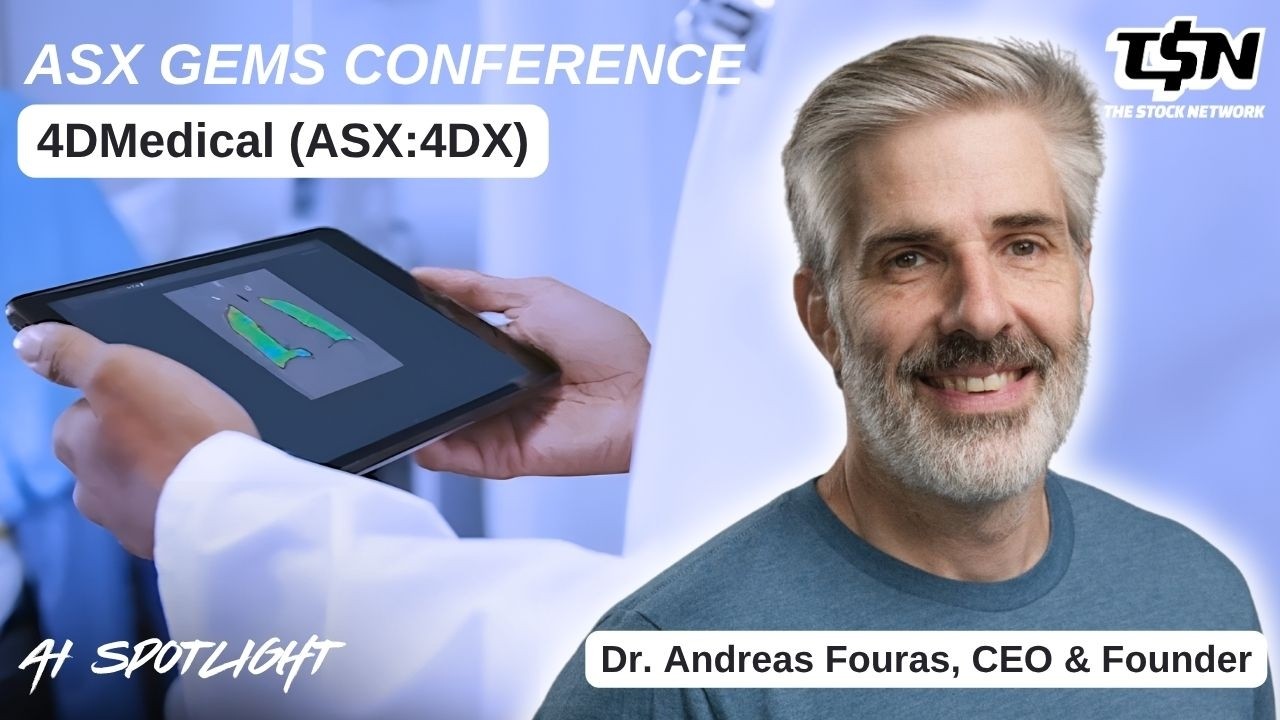
Transcription of The Stock Network Interview with 4DMedical (ASX:4DX), Co-Founder and CEO Andreas Fouras
Andreas Fouras: Hey there, it’s great to be speaking to you today about 40 Medical. It’s been an incredibly exciting 2026, and I’m really looking forward to giving you this update. Of course, we have to take care of the legals.
40 Medical now has the widest, broadest portfolio of FDA-cleared technology to allow doctors to see inside the heart and lungs of any other company, big or small. We do this with a remarkably small team of 175 team members across three continents. The key thing that we deliver is that we show how the lungs work as opposed to how they look.
This is something that has been offered by other technology in the brain, in the heart, in technology like ultrasound, but lung CT and heart CT has been a little bit slow to bring that capability. 40 Medical does that in a way that’s incredibly high value by offering it as a software as a service. We’re not talking about the invention of a new type of MRI as was required for cardiac MRI or cardiac CT, but we use the exact same technology that’s there today, the same infrastructure, and we layer our technology on top of that.
Of course, the thing that most people are excited about for 40 Medical is our latest third-generation product, our CTVQ technology. The first target that we’re looking to assist in that space is to display something called a nuclear VQ. In the United States, this here is what a nuclear VQ looks like.
It’s quite a hassle to get this technology done. You have to go down into a special department, inhale a radioactive powder so it sticks to the inside of your lungs. You then spend 20 minutes in a scanner to get that picture on the left.
You then have radioactive dye injected to your blood, and you then align the scanner for another 20 minutes to get the picture on the right. Or just from the CT scan that you already had, 40 Medical can layer its software on top of that and give you these clean, crisp, three-dimensional color images to replace these blurry, two-dimensional black and white images. That’s incredibly exciting.
Recently, a paper has been published to say that if you use our technology, CTVQ instead of nuclear VQ, you can increase the success rate of lung volume reduction surgery from 46% to 76%. That’s a significant value add that you get from having clean, crisp, three-dimensional images as opposed to the more blurry, limited, unquantitative two-dimensional images that the competing technology offers. We can use CTVQ absolutely wherever you use nuclear VQ.
For bronchoscopic reduction, for surgical LVRS, for resection, for angioplasty, and of course in chronic disease management. We can layer that across, which adds up to there being about a million scans a year that we can replace with this technology, offering a 500 million US market as we can charge 500 US per scan. We’re absolutely confident that we’re going to capture that entire market.
Why? Because there’s this once-in-a-generation circumstance where 40 Medical has been able to engineer that all of the five characters in this story, the patient has better value. They don’t have to go get into a booking cycle to get a nuclear VQ scan. They don’t have to inhale and inject radioactive material.
The referring physician, the surgeon, gets significantly better value. They don’t have to wait for weeks. In fact, Dr. Joe Sesenia from Cleveland Clinic just presented a few weeks ago in the United States saying that using CTVQ reduces the cycle of planning for his procedures from seven weeks to three weeks, so a four-week improvement in that planning cycle.
That is hugely valuable to him, his practice, and the patient. The imaging provider value, the radiologist is better off because of the $650 reimbursement that we have. The current incumbent, and here’s something that’s pretty unusual, the nuclear VQ departments are better off by skipping this procedure that, in fact, they lose money on, allowing them to move on to the latest and greatest technology that they’re really there to deliver.
All of this adds up to improved value for the hospital provider. This no-brainer means that hospitals across the United States are rushing to take up the technology. We have five of the top 20 hospitals in the United States, four of the top 20 interventional pulmonology hospitals, and four of the top 20 hospitals overall already using that, and an incredible pipeline of more of them lining up to get in there and to use it.
One of the things we’ve seen, as we’ve seen with the renewal of Cleveland Clinic, as we’ve seen with SimonMed signing up their 170 sites, as we progress, it’s getting faster, and the terms of our contracts are getting better and better. So, just to get down to where we’re at and what we offer, we’re sitting over the top of this million scan per year nuclear VQ market, and the rate of delivery, the rate of acceleration, has never been faster. We’ve just added our European business, and that European business within weeks has been winning contracts.
We’ve just been approved in Australia with TGA, and once again, with weeks, we now have more than a handful of sites. We have multiple sites across Australia using it, with a bunch of others lining up to get in behind there as well. As I said, with the top tier sites in the United States using it, and the fact that every person in this story is better off by changing over from nuclear VQ to CTVQ, we have this 1 million scan market.
Also, we’ve started recruiting, incredibly exciting. We started recruiting in our CLEAR study, and this multi-center, multi-national perspective study led by leading doctors from Harvard Medical School, and it’s going to read out in 2026, is going to show that not only can we replace nuclear VQ with CTVQ, but we can also replace CTPA. The study is going to be incredibly well-powered, and that adds another 5 million scans.
So in total, we have at least 3 million scans a year at 500 US dollars to us. That’s a multi-billion dollar market that we are going to be in, in just a few short years. We’re demonstrating right now, we are doing all the things today to bring that to bear, and the pace at which we’re going is faster than any other company in this space has ever gone.
It’s incredibly exciting, and I can’t wait to see where we go from here. Thanks a lot for your attention.
Ends