
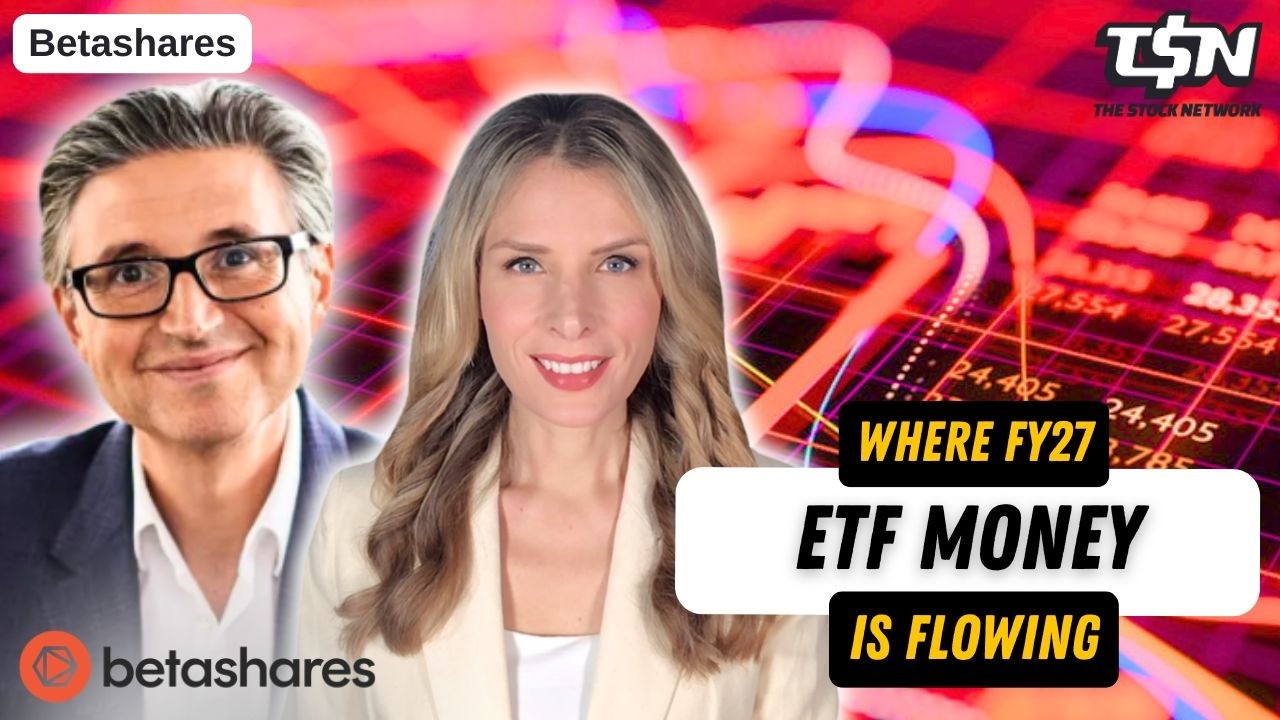
Transcription of The Stock Network Interview with Betashares, Founder and CEO Alex Vynokur
Lel Smits: Alex Vinokur has grown BetaShares into one of Australia’s largest investment managers with more than $80 billion in assets under management and more than 1 million Australian investors. More broadly, Australia’s ETF industry has surpassed $364 billion in funds under management following another year of record inflows, with the number of Australian ETF investors rising to 2.7 million and expected to approach 3 million this year. As investors navigate AI, global equities, fixed income, portfolio construction and evolving market conditions, I’m joined today by BetaShares founder and CEO Alex Vinokur to discuss the key ETF trends that are shaping the year ahead and where investors are directing capital.
Alex, welcome to the Stock Network.
Alex Vynokur: Thank you. It’s great to be with you.
Lel Smits: Now, Australia’s ETF industry has surpassed more than $364 billion. What do you believe will be the defining ETF trend of the year ahead?
Alex Vynokur: Well, look, I think the story of continued ETF adoption is very much continuing to accelerate. You know, ETFs have proven themselves over the last several decades around the world as being a fundamental building block for portfolios of millions and millions of people.
And the rate of adoption of ETFs in Australia is continuing to accelerate. You know, what we’re seeing is that ETFs are evolving. ETFs are today serving as the absolute core foundational building block for so many portfolios, for investors that are starting to invest, for investors that are building their wealth and looking to grow their money, but also importantly for a significant number of investors who are thinking about retirement and investing, you know, sort of for the later stage, you know, in their lives.
So what we’re seeing is that exchange-traded funds as an industry have evolved significantly. We now have a very significant number of products available in Australia and around the world. And the rate of adoption is really driven by the key fundamentals being diversification, cost effectiveness, accessibility, and of course, performance after fees of ETFs has been speaking for itself.
Lel Smits: Yes. And Alex, when it comes to global versus local, over the last year, we’ve had international equities that have attracted that strongest inflows. What’s your outlook for this train continuing in the year ahead?
Alex Vynokur: That’s a great question, Lel.
What we’re seeing with exchange- traded funds is that they’re bringing the world of opportunity to Australian investors. I mean, Australian economy is predominantly defined by a very strong financial sector with the big four banks and some of the other financials, including the insurance companies. And we have a really solid mining sector and resources sector.
Those are really the strongest pillars of the Australian economy as it stands today. At the same time, the world is full of opportunity outside of those sectors. We’re being completely redefined by technology.
Technology is permeating everything from retail to travel, you name it. So ETFs provide an incredible access point to the world of opportunities, whether it’s the Nasdaq 100 companies, some of the companies that are revolutionising the way we live our lives, whether it’s some of the more thematic exposures such as global cybersecurity, which is more relevant than ever, or AI, which, of course, is something that we live with now every day. ETFs really bring those global opportunities to Australian investors.
And that’s one of the key reasons why we believe that international equities is going to continue being a driving force behind continued growth in ETF adoption. But as I mentioned before, we also have a great deal of solutions that ETFs facilitate with local allocations, be it in fixed income, be it in equity income from Australian banks and other financials. So ETFs are a flexible investment tool, and we are very positive on continued evolution of the industry to deliver investment solutions for a growing number of Australians.
Lel Smits: Yes. And Alex, you just touched on thematic investing. And as we all know, AI has been a major driver of this market performance and investor interest over the last year and still. But looking ahead, perhaps what thematic opportunities do you think are looking the compelling?
Alex Vynokur: Well, look, I’ll pick up on the AI point because there’s no denying of the fact that artificial intelligence is absolutely now changing the way we go about our lives on a daily basis, and that will only continue to grow. I think the important thing to note with artificial intelligence and a really well-constructed thematic ETF, and we manage some of them, but some of our peers in the market also have offerings, the important thing to look for is beyond a small handful of leading technology companies that we all hear about all the time. AI is a lot more than just the cutting-edge large language models.
It incorporates a thematic exposure, will incorporate allocation to commodities that will benefit from the growth of artificial intelligence around the world. Infrastructure, including digital infrastructure and data centers. There’s so much more in terms of the value chain of artificial intelligence that we think investors should have exposure to in a well-constructed thematic ETF.
Cybersecurity, of course, I touched on a little bit earlier, absolutely crucial. I think the world today is increasingly digital. All of our wealth is now stored in bank accounts, which we increasingly access through digital access point.
In today’s day and age, very few bad guys basically stop you on the street and ask you for the wallet. They try to access your personal information. They try to access your financial details online.
Cybersecurity is really redefining security, basically, for all of us. We are seeing governments, private corporations, and individuals spend hundreds of billions of dollars a year on cybersecurity. In terms of long-term investment megatrends, those are definitely very good examples.
Lel Smits: For investors new to ETFs, what are the biggest misconceptions about ETFs? Also, why are they increasingly becoming a core portfolio building block?
Alex Vynokur: One of the reasons I started BetaShares now over 15 years ago is to really democratise access to good investing. The vast majority of us are not born as good investors. I think one of the biggest misconceptions is that investing is difficult.
A lot of people stop at getting started or before they get started. One of the reasons for that is because there is a significant misconception about the fact that you need to be a professional in order to invest well. One of the things we have been building at BetaShares over the last 15 years is a variety of investment products.
Some of them are phenomenal core building blocks for somebody who is just looking to get started. Diversified investment portfolios, such as some of the ETFs that BetaShares manages, would be a phenomenal way for people to get started. Then you can build around it.
You can build on top of that to create a more bespoke experience, a more bespoke portfolio in line with your investment objectives.
Lel Smits: Alex, as someone who has spent decades in the markets, how has your own investment approach changed over all this time?
Alex Vynokur: My personal investment approach is pretty simple. The one thing that I’ve recognised many decades ago is timing the market is really, really hard.
Time in the market is much more important. Having a diversified, cost-effective investment portfolio is really fundamental. But what’s also really important is to not let your emotions get in the way of long-term compounding of returns.
The one lesson that I have learnt over time is that it is impossible. It is impossible to time the market. It is a very bad idea to try to engage in high-frequency trading, basically, as an investor, thinking that you know more than the market does.
The power of compounding is one of the most powerful concepts in investing. What we do as a business with BetaShares is really empower our investors with really good investment tools, but also a significant amount of educational content to help them be more confident and help them be more knowledgeable as investors.
Lel Smits: And finally, Alex, we’re hearing all the time now that ETFs are at record highs and the interest and demand is suddenly growing.
The Australian ETF industry recently forecast it could reach $500 billion by 2030. But looking ahead, what gives you personally confidence that the year ahead will be another strong one for ETF adoption? Well, the first thing I’ll say is that I measure the success of the industry and I measure the success of our business, not just in terms of the year ahead, and in fact, less so in terms of the year ahead, but really decades ahead of us. And one thing I can tell you is that if you look at the statistics for the industry overall, and of course for BetaShares too, every year over the past decade or so, we’ve seen very strong net inflows into the ETF industry, and we’re seeing very significant net outflows from the traditional managed fund space.
I think the investor experience of ETFs is superior compared to unlisted funds. And also, as I mentioned before, the returns net of fees tend to speak for themselves and tend to be significantly superior. So what I’m really positive about is the fact that despite that significant growth that we’re all reading about and hearing about in the ETF industry, ETFs in Australia still represent only 6% of the overall managed fund space.
So the room for growth is very, very significant. If you look at the market like the US, ETF penetration today is well over 30%. In a number of other global markets, that ETF penetration is significantly ahead of where Australia is today.
But what we’re seeing is that Australian investors, and again, that’s all borne out in statistics that you can read from a number of sources, Australian investors are increasingly voting with their feet in choosing ETFs as the better way to invest. So that probably is the main point that I would make. Well, it certainly is a strong point and compelling point for the future of ETFs.
Lel Smits: Thank you so much for your insights today.
Alex Vynokur: Thank you. And it’s great to be with you, Lel.
Ends