
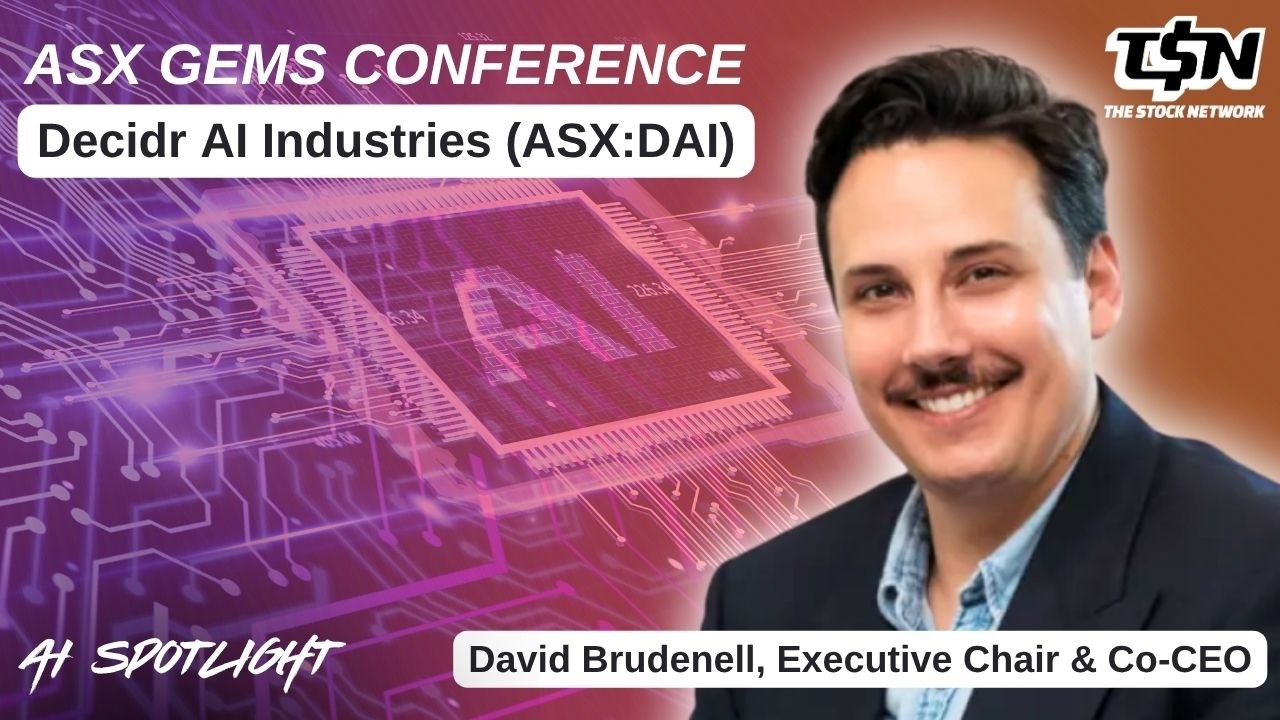
Transcription of The Stock Network Interview with 4DMedical (ASX:4DX), Executive Chair and Co-CEO David Brudenell
Lel Smits: AI is moving from experimentation into everyday business, creating demand for technology that can capture knowledge, automate workflows, and deliver measurable productivity. Decider AI Industries is targeting this next phase through Decider OS, SugarWork, and Rumi, with the company now fully owning Decider.ai, expanding its U.S. presence and building a growing technology partner network. Decider AI Industries Executive Chair and Co-CEO David Brunel joins me to discuss where enterprise AI is heading, how businesses are operationalizing the technology, and where the company is looking to for growth.
David, welcome to The Stock Network. Thanks for having me. Now, as businesses are shifting from AI trials to deployment, what do you think is driving this transition, and where does Decider OS fit into it?
David Brudenell: Sure, businesses are transitioning into production, but very few of them.
I think many businesses are still stuck in that piloting phase at the moment, and businesses are moving towards production. Their desire is very much to move towards that because businesses have become more comfortable in using AI tools. Just like 12 months ago, people were just understanding what a prompt was and how to use it properly.
They’re now talking about agentic AI. Our world was filled with Claude bots, and they’re hacking things like Hugging Face. So businesses are becoming, they’ve metabolized the way that AI kind of, they understand AI, and now they’re comfortable.
They’re starting to kind of look for areas in their business where tasks in their businesses could be potentially replaced by AI. So I think the maturity is more so language and technology metabolizing and understanding in the businesses, and now they’re kind of, they’re cross-acting that with what’s happening inside their companies today, and they’re becoming a little bit more comfortable. But I do think there is still some time to go where businesses are truly comfortable to start putting AI into production, because AI today is still super guessers.
They’re still probability machines, and businesses need determinism. They need to have their payroll run the same way every single time. And I think when we reach that point where workflows or work is a lot like manufacturing, that’s when businesses will be move head-heartedly and full speed into AI workforce production.
Lel Smits: And David, Decider AI Industries has partnered with SCX.ai as it builds its sovereign AI infrastructure offering. How important is this infrastructure layer to scaling Decider OS, and how do you see the partnership opening new enterprise and government opportunities for Decider AI Industries?
David Brudenell: It’s incredibly important, and there’s a number of reasons why sovereign inference is really important. So the first thing is businesses today are getting wise that everything that they put into these foundation models, every prompt that they put in, is actually their decision logic.
It’s their IP, and they need to protect that. So the way that you do things is almost more important than what you do today. And so having sovereign inference and protecting that knowledge is going to be really important for businesses.
And so for us, we provide services for businesses to capture that knowledge and to use it to train your own sovereign large language models, which when run on SCX provides sovereign inference or protected inference for those businesses. So that’s kind of step one and why our partnership is so important. Step two is that once these models start to run on our operational AI platform at Decider, so think about Decider as very much like manufacturing.
So where knowledge work today in a meeting room is kind of ambient and everywhere, what we do is we productize, we put it on a production line. And when with that production line, it’s run the same way every single time, those tasks and workflows. And so having a infrastructure partner like SCX who can protect those workflows and have them domiciled in Australia, as opposed to being flowing across to foundation models overseas, is really important.
And so that provides certainty and resiliency for our customers. And lastly, from a sovereign perspective, Australia is, although it doesn’t sound like that, I am an Australian, and Australia has a great opportunity to become one of the agentic superpowers around the world. Australia geopolitically and geographically has all the resources, both knowledge resources and actually physical resources, all the way down to the sunlight above our heads, to the stuff that’s in the ground that goes into making chips, and SCX provides and links that in a much more cost-effective way than typically the GPUs or the TPUs that are out there.
So for us, when we’re thinking about Australian resiliency or Australia as a superpower, partnering with SCX is a really great opportunity. And both of our businesses being publicly listed on the ASX provide us with key governance, auditability, and that trust that we think enterprises in Australia are looking for. And David, finally, the opportunity ahead for you with a growing partner network and also that US expansion underway, how large do you think the operational AI opportunity could become for Decider AI industries? And also, what do you think will drive its next phase of growth? Yeah, so I think everybody today, when they think about AI, they think about the software market or the SaaS market, and that’s about $300 billion.
And that’s a fight that we’re really not focused on at Decider. What we’re focused on is the labour in the economy. And if you look at the United States, as an example, about $10 trillion a year is built into knowledge, is built into work, and those are tasks.
So that’s what we’re chasing. We’re chasing the labour that exists in businesses today. And really importantly, AI does not replace jobs.
AI replaces tasks in workflows. So at Decider, we’re all about finding the right place for AI in the workflow and the right place for humans in the workflow as well. So we see like an incredible opportunity.
We’re about, we’re going into big markets as a business, and that allows us to open up huge opportunities, not only here domestically in Australia, but also moving into the United States, which we acquired a few businesses over the past year and are aggressively moving into. And our partnerships are really exciting because our partners allow us to get entry and not only helping them transform their businesses into AI companies, but they offer us access into their customers. And that distribution, if software is becoming cheap because of AI, the distribution is very valuable.
So we’re really excited to push into those sectors and in those new geographies.
Lel Smits: David, thank you for the update from Decider AI Industries, and also thank you for joining the Stock Network’s ASX Gems AI Spotlight. Awesome.
David Brudenell: Thanks a lot. Thanks for having me.
Ends