
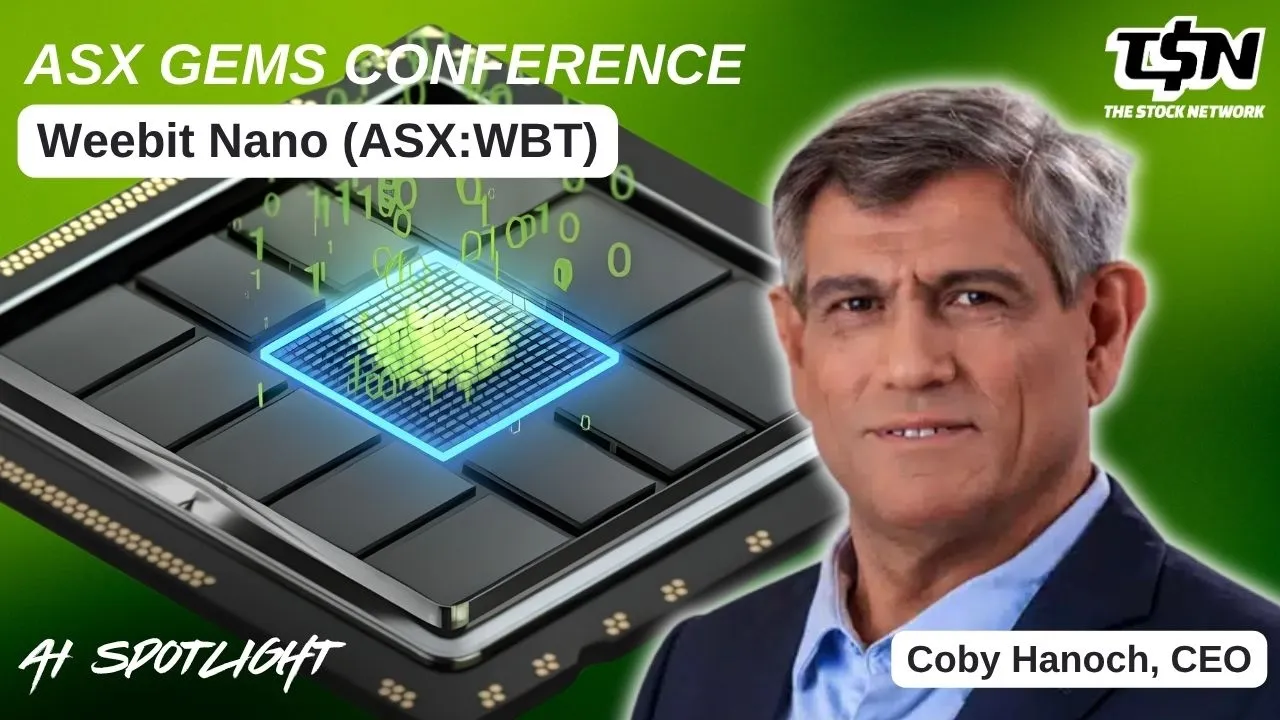
Transcription of The Stock Network Interview with Weebit Nano (ASX:WBT), CEO Coby Hanoch
Coby Hanoch: I’m Cobi Hanock, CEO of Weebit Nano, and I’m here to introduce you to the company and what we do. Weebit is in the semiconductor space, today that’s becoming the most important market in the, I guess, on this planet. We are focused on developing non-volatile memory for the semiconductor world, which basically means the memory that doesn’t lose its data, even when you unplug it from power, like an SSD drive or a USB stick, etc.
If you think about it, any electronic device has what I call the magical moment. You turn it on the first time and you expect there to be some software, some data, etc. running on it, so that’s where NVM, non-volatile memory, comes in.
You can see on the right side that the top nine market cap companies in the world today are semiconductor companies. Anything you touch today has semiconductors in it, just as a field. A new car has many thousands of semiconductor components in it.
And you can see here the fast growth, especially with AI, the fast growth of this market and how this year it’s expected to actually double and continue to grow as we move forward. So, the growth has been really accelerating because or thanks to AI. The semiconductor market is a very diverse one.
There are a lot of players in this market. The key players are the fabless companies and the foundries, the ones that design the components and the ones that manufacture them. They all, at the end of the day, need the building blocks for the designs for these chips.
And the key part is the IP. WeBit actually develops IP modules that can be plugged into these products. So, because everything in semiconductors has been shrinking so much and you can put so much on a single chip, the customers actually put a full system on a single chip.
And what they do is they design the core of the chip and then they add all of these IPs around it. You need an HDMI, you need a Wi-Fi, you need whatever. You just plug these like a big puzzle in there and then you go to the foundries to manufacture.
So, WeBit licenses this technology to the fabless companies so that they can embed it into their products. And it licenses, it gives the manufacturing license to the foundries so that they can manufacture it. Now, embedded non-volatile memory is really everywhere.
Everyone needs non-volatile memory. You can’t have processing happen without non-volatile memory. So, it is in all applications, in all of the modern electronic devices, and really having a good non-volatile memory is a key differentiator.
You can look at the different market segments. Automotive, I already mentioned. Cars have today thousands of electronic components with non-volatile memory in them.
This is a very fast-growing market with autonomous vehicles, etc. You have power management. Today, you don’t just plug things into the wall.
There’s always that box that controls how fast or slow you charge the batteries, etc. That’s a very big market. Of course, AI is a very big market and growing rapidly.
IoT, all of these devices, the wearables, the cell phones, the watches, etc., etc. So, in healthcare and everywhere else, you really need it everywhere. That’s why today, the existing technology that people are using is called Flash.
That’s what today all of the products practically have in them. But Flash has been really hitting the wall for 20 years now. We’ve already known that Flash will hit the wall.
It has too many limitations. It’s an old technology. The market today is moving to emerging technologies, which are now growing very fast.
You can see here on the left how this market is growing from $300 million this year to over $4 billion in just a few years. So, really, very fast growth of the new non-volatile memory technologies. The technology that WeBit is developing is called ReRAM, resistive RAM.
This is actually a very competitive technology because it has many advantages over Flash, but the key one is it’s just cheaper to manufacture than Flash and definitely than other options. So, you can see also how the ReRAM market share is growing, and I think it’s quite acceptable already in the market that ReRAM is going to be the dominant technology as we move forward. So, WeBit is in a very good position right now.
We have qualified the technology, which basically means it’s ready for mass production. It went through very rigorous testing that were defined, tests that were defined by standards bodies, and we showed that we can withstand very high temperatures for a very long time and meet all kinds of other criteria. We are today practically the only independent supplier of ReRAM that can actually provide it to the market that’s qualified.
So, we’re in a very good position, and it’s really a great market to be in and growing very rapidly. By the way, because ReRAM is much cheaper to manufacture than the other technologies, while the market share might be 50 percent in a few years, you can see on the right-hand side the number of silicon wafers that will be manufactured with ReRAM, which is already a much, much larger percentage. WeBit has been making very good commercial progress.
We started off by licensing to Skywater and then to DB Hitech, a big foundry in Korea. Later, we continued with OnSemi and Texas Insurance, two of the biggest players in the analog space and automotive, et cetera. So, we’re really feeling very bullish now.
Big players have endorsed the technology. The market is recognizing it, and we’re expecting rapid growth. In terms of our advantages, our ReRAM is much cheaper to manufacture.
We have already shown that even key players are using it. The technology itself is orders of magnitude faster than flash, lower power consumption than flash. It’s great also for AI.
We have actually showed that this technology can be used for what’s called in-memory compute, which drastically lowers power consumption in AI. The company is in a strong position. We did a raise this year of over 100 million Aussie dollars.
We have a very strong team, and we believe we have a very strong future. Thank you.
Ends