
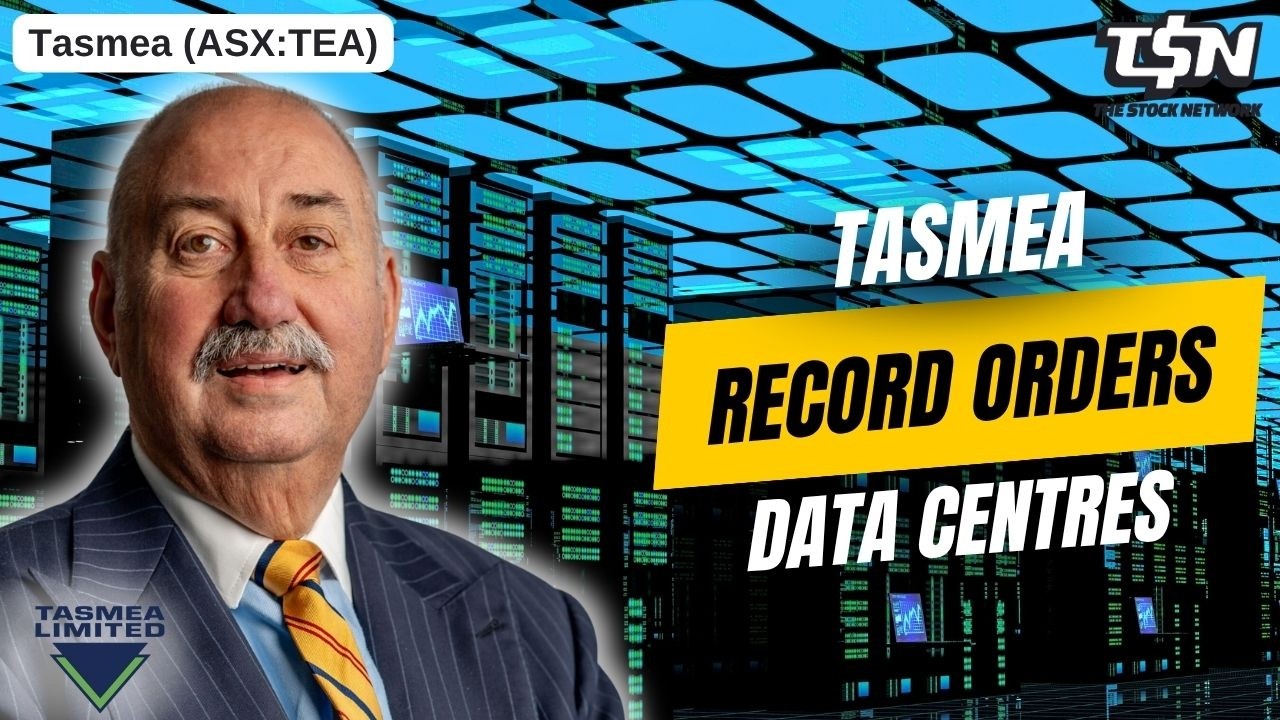
Transcription of The Stock Network Interview with Tasmea (ASX:TEA), Managing Director Stephen Young
Lel Smits: Tasmea provides specialist trade services to the mining, energy, infrastructure and data centre sectors across Australia and has upgraded its FY27 earnings guidance after a record FY26 result. The group has completed the maximum JPS acquisitions and built a record order book. Ahead of presenting at TIPS conference, I’m joined by Managing Director Stephen Young to discuss electrification demand and the year ahead.
Stephen, welcome back to the Stock Network.
Stephen Young: Thank you very much. Good to be here and thank you for taking the time to interview me.
Lel Smits: Great to have you on as always, Stephen. And look, since Tasmea’s April 2024 IPO, shareholders have seen total returns of more than 500%. Can you outline for us, Stephen, what has enabled that performance from your perspective?
Stephen Young: I think most of us should start by saying our business model is unique.
So first of all, our business is founder-led. Mark Bartoli, my business partner now of nearly three decades, Jason Pride, one of our executive directors, and myself own over 55% of Tasmea. So we’ve got a lot of skin in the game and that most probably influences our culture.
We run, as you’re aware from last year, a decentralised culture. So that now means we’ve got 28 businesses led by 28 separate chief executives and their team, and that enables the businesses to remain really close to their customer and really close to their employees. And that owner-manager culture makes a big difference when compared against a corporate culture.
And then finally, we provide specialist services. So think of us as orthopaedic surgeons, not general practitioners. But really importantly, we’re involved in maintenance, not construction.
We’re involved in production, not exploration, which isolates us from commodity price swings. So it’s a combination of the way that we grow by acquisition and the way we compound that growth organically by cross-selling.
Lel Smits: Yes, and Stephen, Tasmea recently acquired Maxim, one of Australia’s leading data centres with AI cloud computing, also electrification, driving unprecedented investment in data infrastructure.
How are you really looking at this opportunity and seeing it develop from here?
Stephen Young: I think I’ll start with maybe something which is obvious to most experienced investors. Australia, as a nation, follows technically the United States. So our development of data centres must be running three or four years behind the trends in the US.
So AI is very much with us. The growth is eye-watering in terms of businesses’ use of artificial intelligence and the need to store data in data centres in order to be able to provide that service to the end users. Australia has begun that tidal way of data centre construction.
First comment that I make is notwithstanding all of the enthusiasm and the hype, it just would not be possible to develop data centres in Australia, or for that matter, anywhere else in the world, as quickly as the Neo cloud and hyperscalers would like. So their demand will exceed the market’s capacity to deliver. And we’ve seen the, for want of a better way of describing it, the shockwaves of that flowing through capital markets currently.
The first point I’d make is what was never going to be built is not going to be built. So that sounds like nothing is going to help and nothing is going to be done. That’s the message I’m trying to give.
So the development will be huge, very significant, and ultimately, we’ll get to a point where the labour that we’re providing will be the constraint. But for today, it’s available power, available water, available land, and most probably the major constraints to meeting the exceptional demands of that industry. My view, it will triple in size from where it is today over the next couple of years.
Lel Smits: Okay, Stephen. So from AI to, of course, mining and resources, they’re expected to account for around three quarters of Tasmea’s earnings before interest and tax. What’s your outlook therefore, in terms of activity across iron ore, copper, gold, gas, also coal?
Stephen Young: So again, it’s interesting, as I mentioned earlier, we are protected against commodity price swings, because we work in the maintenance sector in the main.
But if you stay with iron ore, they’re expecting to deliver more tonnes than last year. So looking at how it’s going to impact our business, more tonnes equals more work. You then go to copper, copper contributed financially more money last year to Rio and BHP than iron ore.
They also are planning to sell more tonnes this year than last year. More tonnes, more work for us. Gold still remains over 4,000 US a tonne.
Sorry, my apologies for Tom, that will be announced. We think that that sector, with all of the volatility that’s going on in the world, will continue, but that’s more than three times the long term average price for gold. Gas, liquid natural gas is now Australia’s second largest export.
We’re selling as much as we can. I think gas reservation won’t impact the demand for our services. If anything, it will increase it.
Then finally, coal. People have been going to the foreshadowed funeral service for the coal industry now for a couple of decades. I reckon they’re a couple of decades early.
It’s a pretty healthy 60 year old. Might not live to be 100, but I reckon we’ve got a couple more decades still to go. Okay.
Lel Smits: And finally, in terms of balancing growth and risk, Tasmea has grown quickly. Through both acquisitions and that organic expansion that you’ve discussed today. But Stephen, looking ahead, how are you going to be balancing an entrepreneurial culture, also with that discipline that’s needed to manage risk and margins, also execution as the group scales?
Stephen Young: I think a couple of things, as I mentioned again earlier, Mark and myself have over 55% of Tasmea.
I don’t think there’s any purpose to be served in me trying to convince you that I’m not entrepreneurial. But most of my wealth, very close to all my wealth, is at stake in Tasmea. So both Mark and I are very conservative.
We’re trying to protect our equity along with the other investors’ equity alongside us. So half a dozen things that are quite different. First of all, Tasmea Limited doesn’t trade.
Tasmea Limited is a holding company. So we trade with our very large clients, BHP, Rio, et cetera, through one or more of our subsidiaries. We do not give parent company guarantees.
So immediately we limit our risk by only contracting through one of our subsidiary companies. We don’t cost guarantee our performance by those companies. We do provide bank guarantees that we do what we say we’re going to do when we say we’re going to do it.
But we’re never betting the entire farm. As you know, those 28 companies operate all around Australia. So we don’t have single site geographic risk.
And then on top of that, we work in half a dozen different industries and even in the mining sector. We’re involved in mining, as you mentioned previously, half a dozen different commodities, iron ore, copper, gold, et cetera. So the diversity limits our risk.
We are entrepreneurs, we do buy businesses, we do build businesses, but we manage risk along the way in order to protect your equity and our equity.
Lel Smits: Well, Stephen, I appreciate the update from Tasmea today. Look forward to hearing more when you’re on stage at TIFF Group’s Investment Conference.
Stephen Young: I’m looking forward to it as well. Hope to see you there.
Ends