

- Global private debt assets under management have passed US$2 trillion, more than tripling over the past decade.
- Pengana Global Private Credit Trust (“Trust”) is diversified across underlying funds, managers, and geographies (US and Europe).
- The Trust delivered a 12-month income return of 8.8% to June 2026.
- Pengana’s white paper says 2026’s redemption and software-sector headlines reflect specific issues relating to managers or concentrated exposures, not a systemic credit event.
Private credit used to be the preserve of pension funds, insurers and sovereign wealth managers. It has grown into a global market worth more than US$2 trillion.
Pengana Credit lays out the case for it in a new white paper, Global Private Credit in a Changing Capital Market. Pengana Global Private Credit Trust (ASX:PCX) gives everyday Australian investors a way into that market. Its structure is built around one simple fact. The loans inside it can’t be sold in a hurry.
A growing asset class now open to retail investors
Private credit is simple. A company borrows money directly from a fund manager, instead of a bank or the public bond market. The loan isn’t listed or traded. The lender holds it until it’s repaid.
That structure has become a much bigger part of how companies get financed. Banks have pulled back from lending to mid-sized companies since the 2008 financial crisis. Capital rules have tightened further, making certain loans expensive for banks to hold. Public bond markets work for large, simple borrowers. They don’t suit a company that needs a fast, flexible or confidential deal. Private credit managers filled that gap.
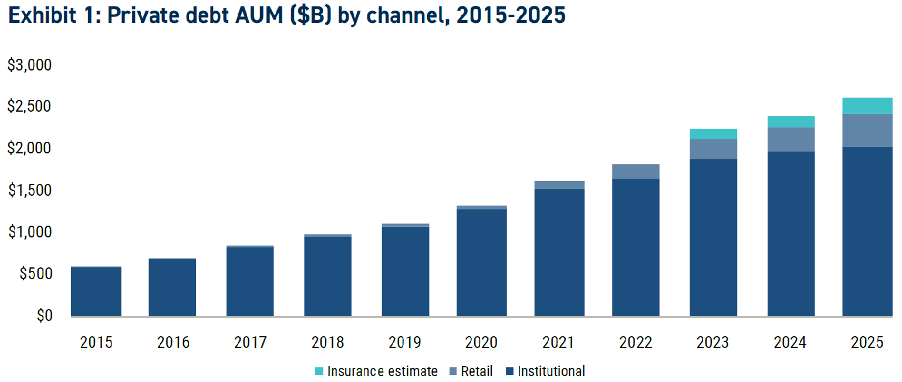
Global private debt assets under management, by investor channel. (Source: Pengana Credit white paper, “Global Private Credit in a Changing Capital Market” (Aug 2026), citing Pitchbook.)
Global private debt assets under management passed US$2 trillion by mid-2025. Institutional investors (pension funds, insurers, sovereign wealth funds) still own the bulk of it, at 77.6%. Retail investors account for 15.1% and insurance channels 7.2%.
For most of the asset class’s history, an everyday investor simply couldn’t buy in.
How you access private credit matters
Richardson argues that owning private credit and owning it well are two different things, because of how the asset class behaves.

▶ WATCH · Pengana Credit CEO Nehemiah Richardson on the importance of how you access private credit.
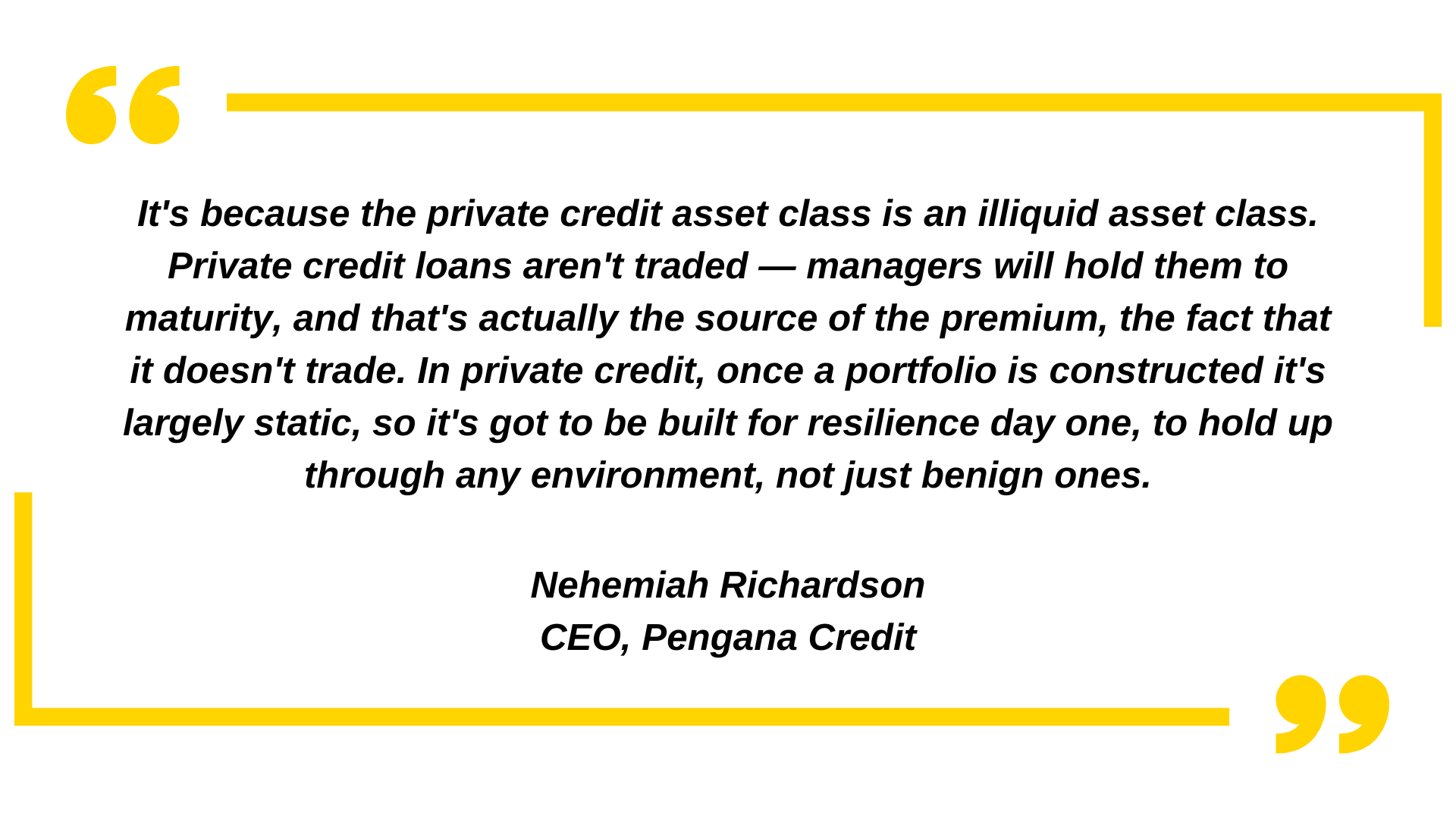 Because a manager can’t trade out of a bad loan, they have every reason to do the work upfront.
They run detailed due diligence. They seek a better deal, senior security and tight lending terms. And they actively monitor the loan once it’s on the books. That’s the trade-off at the heart of private credit. Illiquidity can contribute to a return premium and gives managers a strong incentive to apply disciplined underwriting and monitoring.
It also means the vehicle an investor buys into must solve a liquidity problem created by the underlying loans.
PCX does that in two ways. Units trade daily on the ASX, the same as a listed company like BHP. While units trade on the ASX, investors remain exposed to the illiquidity of the underlying private credit assets and may not always be able to sell units at or near NAV.
Also, investors can apply into a quarterly off-market buyback, priced at net asset value and capped at 5% of units on issue. This mechanism is designed to align unit price with the underlying asset value. Richardson says applications into that buyback have run below the 5% cap every quarter since the Trust listed in June 2024. Participation in any buyback remains subject to the terms of the offer, applicable limits and potential scale-back if demand exceeds available capacity.
Three engines built for different jobs
Pengana splits the PCX portfolio into three strategies, each earning a return in a different way.
Direct lending is roughly 70% of the portfolio. It’s the income anchor. These are senior secured loans to non-cyclical mid-market companies in the US and Europe. The loans are actively monitored and underpin the Trust’s target cash distribution yield of no less than 7% per annum, although this is a target only and may not be achieved.
Credit and specialty finance is the diversifier. Instead of lending to a single company, this sleeve earns income from pools of assets, like mortgages and commercial business loans. Risk here is managed through the collateral behind those pools, not one borrower’s fortunes.
Credit opportunities is the smallest sleeve, at about 14%. It’s capital invested in periods of market dislocation or when a fundamentally sound company can’t refinance on normal terms. A manager can step in then and get paid well for providing that liquidity.
Across the whole portfolio, Richardson says PCX is spread across 30 underlying funds and 28 managers, split roughly 55% US and 40% Europe. About 80% of that exposure sits in first-lien loans, generally the most senior and structurally protected position in a company’s capital structure.
Pengana adds another layer of scrutiny. The underlying managers are selected and monitored with Mercer, the global investment consultant, acting as an independent check on manager quality rather than Pengana picking managers alone. That kind of scrutiny matters more as more money chases the same opportunity. Across the industry, 93% of institutional private debt capital raised in 2025 went to managers running their fourth fund or later, a record, and a sign that experience is being rewarded over new entrants.
Concentration risk, not a credit crisis
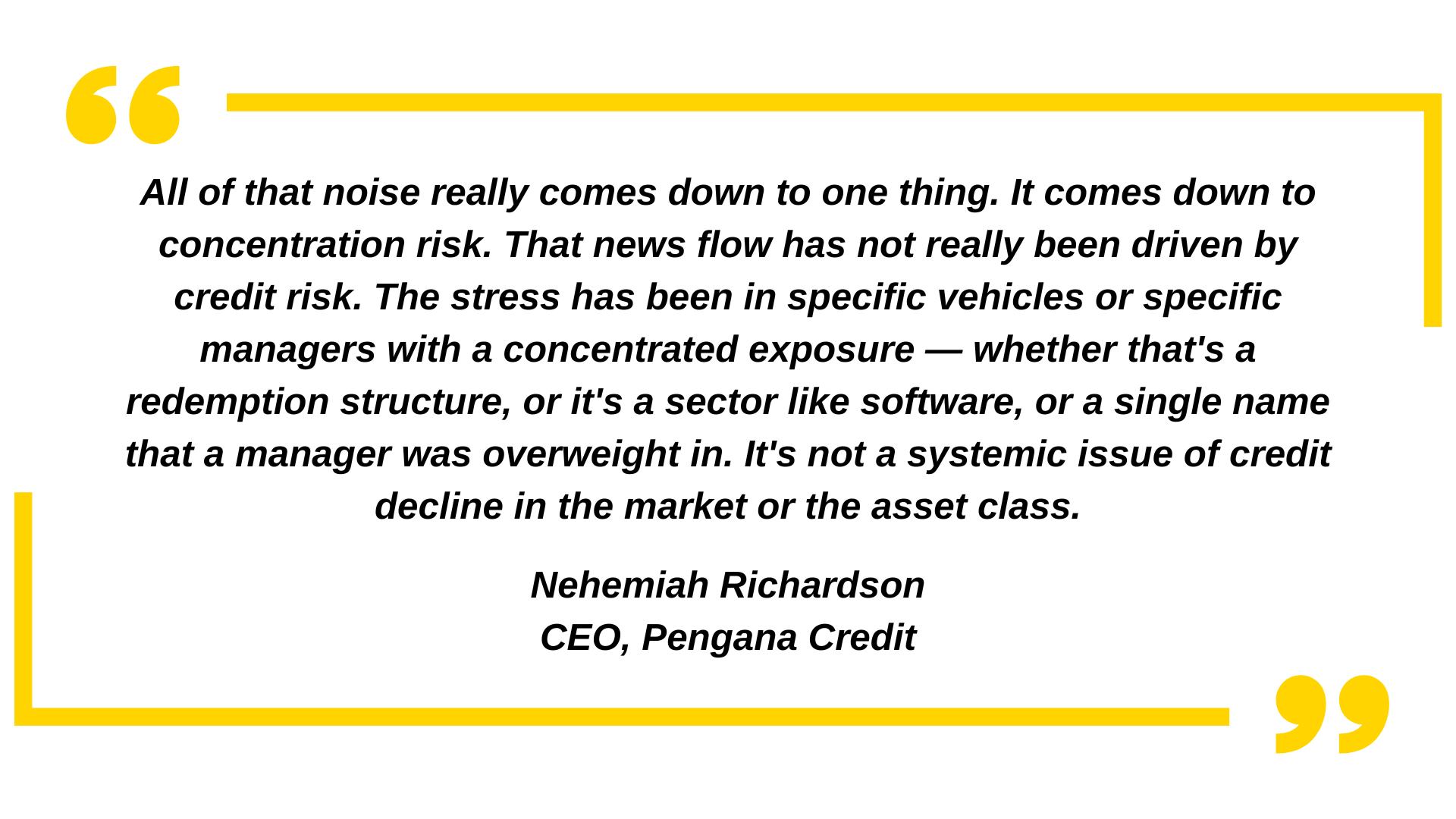
2026 has produced a steady run of private credit headlines. Fund redemptions. Stress in software-sector loans. Concerns about how AI might hit software company earnings. Richardson’s current assessment is that much of the recent newsflow reflects one principal issue: concentration risk.
The wider data backs the distinction between noise and a genuine downturn. Direct lending defaults ran at 1.1% over the trailing 12 months to early 2026, against 4.2% for syndicated (bank-arranged) loans and 1.9% for high-yield bonds, according to the white paper. Forecasts for 2026 put direct lending defaults at around 2%, still below the other two.
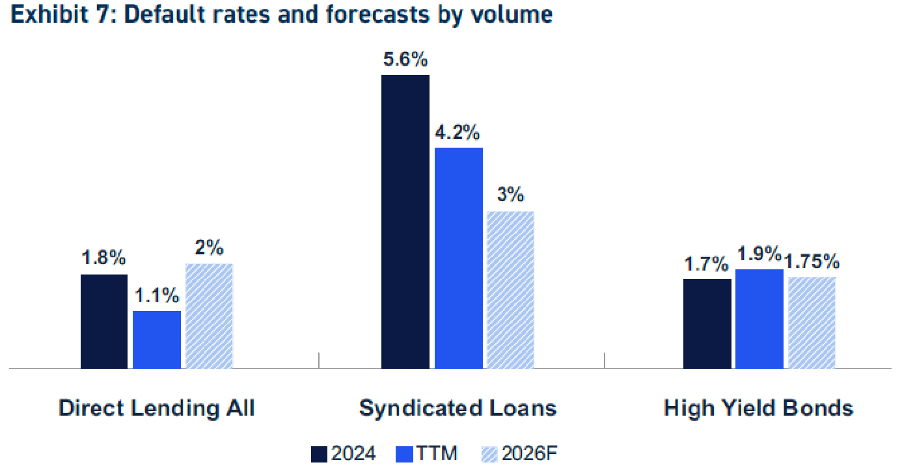
Default rates and 2026 forecasts, direct lending vs syndicated loans vs high yield bonds. (Source: Pengana Credit white paper, citing KBRA Direct Lending Default Research.)
Richardson makes a second point about geography. An Australian investor’s local private credit exposure rises and falls with the Australian economy alone. PCX instead spreads its exposure across the US and Europe, reducing the portfolio’s reliance on the conditions of any single country. He argues that’s the more useful kind of diversification, especially when the asset itself can’t be traded away from a problem.
Where the opportunity sits, and what PCX has delivered
Richardson describes current conditions in the US and Europe, the largest private credit markets, as attractive for lenders right now. New direct lending deals are being priced up to 50 basis points wider than in recent years, with lower borrower leverage and tighter loan documents. That means better terms for the manager writing the loan. He sees the reason as structural, not cyclical. Banks keep retreating from parts of the lending market, and managers like Pengana’s are filling that gap.
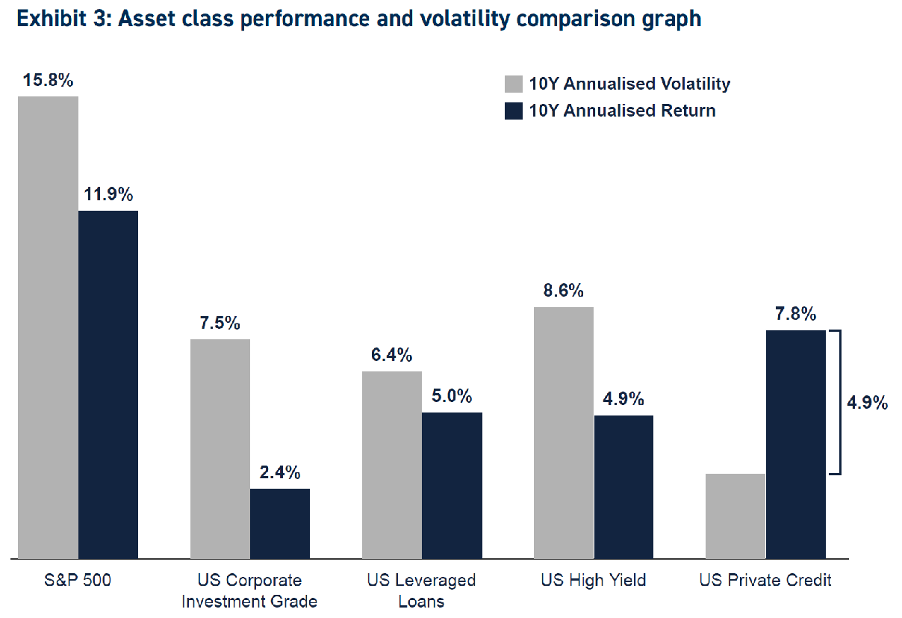
Ten-year annualised return and volatility, US private credit vs public market benchmarks, to 31 March 2025. (Source: Pengana Credit white paper, citing S&P, Bloomberg, Burgiss and Thomson Reuters data.)
Over the ten years to March 2025, the white paper puts US private credit’s annualised return at 7.8%, against a volatility of 4.9%. That’s a smoother ride than the S&P 500’s 11.9% return against 15.8% volatility over the same period. It was also better compensated than investment-grade or leveraged loan indices with similar or lower volatility.
Richardson says that record has continued through the stress of the past year.
He puts PCX’s 12-month income return at 8.8% to June, 2026, ahead of the Trust’s target cash distribution yield of no less than 7% p.a.
He calls it a difficult period for sentiment in the sector. Credit quality across the portfolio has stayed stable, with no signs of deterioration. He expects spreads and manager leverage to keep normalising as the current volatility works through the system.
Pengana’s white paper ends with a line that doubles as PCX’s own pitch. ‘Owning private credit is not enough. Owning it well is the real task.’
Read Pengana Credit’s full white paper, Global Private Credit in a Changing Capital Market.
Who PCX is designed for
PCX is intended for investors seeking income distribution who have a medium risk-and-return profile for the relevant portion of their portfolio, a minimum investment timeframe of three years, and who intend to use PCX as a minor or satellite allocation within a diversified portfolio. Within that timeframe, investors may have the flexibility to access their capital by selling Units on the ASX (subject to an active trading market) or through any buy-back offer made by Pengana. PCX is not intended to be used as a standalone, major or core portfolio allocation. Investors should read the current PDS and TMD before investing.
This article was produced in collaboration with the company featured and the information provided is for general information purposes only and should not be considered financial advice. Readers should consider their own circumstances and seek independent professional advice before making any investment decisions.
Important information
This article was produced by The Stock Network in collaboration with Pengana Credit Pty Ltd and/or its related entities (Pengana). Pengana paid The Stock Network to produce and publish this article. The article includes information supplied by, and statements attributed to, Pengana representatives. Statements reflect current assessment of market conditions, which may change over time.
The information is general information only and has been prepared without taking into account any person’s objectives, financial situation or needs. It is not personal financial advice or a recommendation to acquire, hold or dispose of units in the Pengana Global Private Credit Trust (ARSN 673 024 489, ASX: PCX). Before making an investment decision, investors should consider whether PCX is appropriate for their circumstances, obtain independent financial advice, and read the PDS, TMD and ASX announcements available at https://pengana.com/our-funds/pengana-global-private-credit-trust/.
An investment in PCX involves risk, including possible loss of income and capital. Income distributions and investment returns are not guaranteed. Private credit investments are subject to risks including borrower default, reduced recoveries, illiquidity and valuation uncertainty. PCX units may trade on the ASX at a discount to net asset value, and investors may not always be able to sell their units when they wish. Any off-market buy-back is subject to its terms, limits and potential scale-back. Past performance is not a reliable indicator of future performance.