
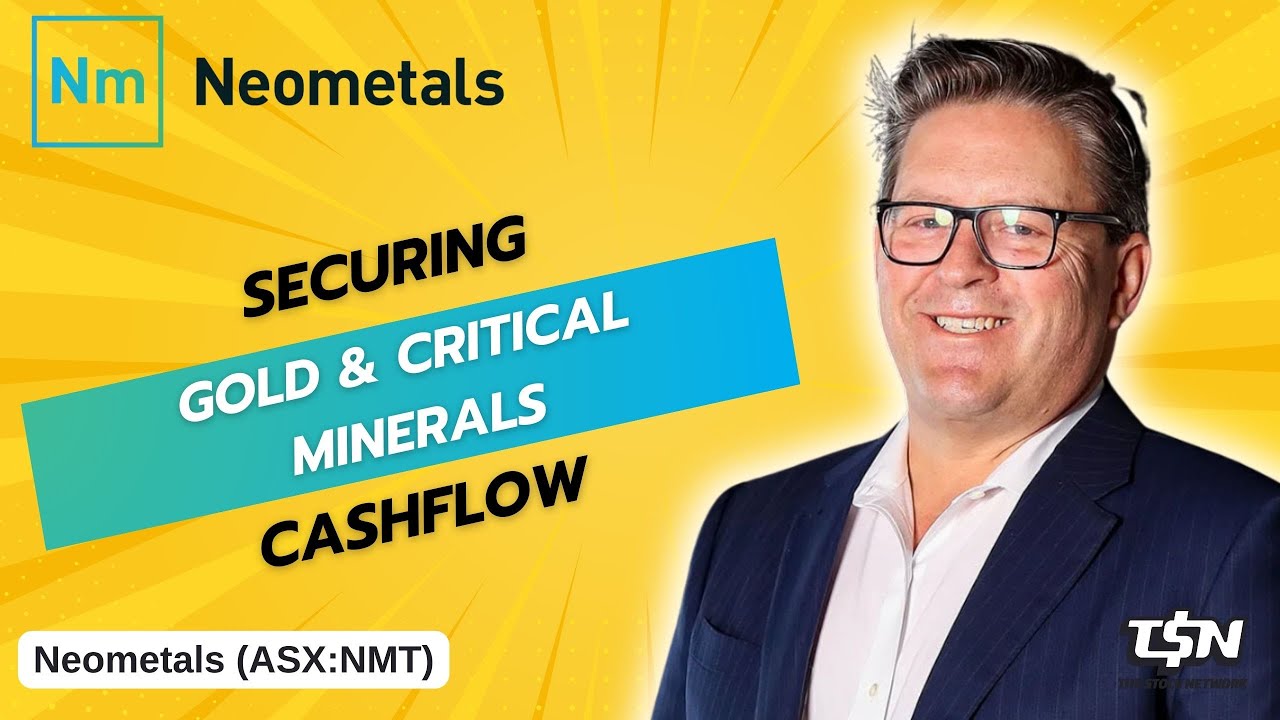
Transcription of The Stock Network Interview with Neometals (ASX:NMT), Managing Director and Chief Executive Officer, Christopher Reed
Lel Smits: Neometals has sharpened its strategy this year, prioritising rapid advancement of the Barambi Gold project towards production to deliver security through near-term cash flow, while positioning its green process technology assets as call options on a recovery in lithium and energy storage markets. Alongside gold, Neometal continues to advance its critical minerals portfolio. Key milestones include a commercialisation memorandum of understanding with Rio Tinto for the Eli process, a €48.7 million business Finland grant supporting VRP technology, and the Utah Brine option providing future lithium exposure beyond hard rock.
Joining me today is Neometals Managing Director and CEO Christopher Reed to discuss how this balanced strategy supports cash flow security and long-term growth. Chris, welcome back to the Stock Network.
Chris Reed: Thank you very much Lel, please to be here.
Lel Smits: Pleasure to have you on. Now, with a production letter of intent now in place, what are the key milestones that investors should watch as Barambi advances towards a development decision over the coming year?
Chris Reed: Yes, sure. To reflect on 2026, we put our maiden drill hole into ironclad in February. We put a resource out in June.
We put a mining lease down in July. We finished our diamond drilling and met test work in the September quarter. We’ve completed the infill and extension drilling in November.
We expect those results to come out in January. A new mineral resource estimate, hopefully try to get that out towards the back end of February. Within a 12-month period, going from first drill hole into an old prospect through to a development decision, which would be executing the full form agreement for a production joint venture within 12-months, I can’t recall anyone moving quicker ever.
In terms of what we should look for, I’ll just say in the first quarter of 2026, because we’ve got big plans beyond that, but in the first quarter of 2026 for Barambi, we’ll have drill results out for ironclad. Then we’ll have drill results out for Mystery and the Barambi Ranges. We’ll have a new mineral resource estimate out for ironclad.
We’ve just got to finish off the full form agreement, a production joint venture with BML Ventures. They’ve got mill capacity. They’ve got a history of completing 6 or 7 of these that I know.
We’ve known the principals for a long time. It’s going to be a very busy March quarter.
Lel Smits: Sounds very busy indeed. If we can look closer at the call options on Lithium and energy storage, how do Eli, VRP and the Utah Brine option provide leveraged exposure to future Lithium and energy storage demand while also preserving capital discipline?
Chris Reed: We’ve taken a partnering approach on Eli. We own at 7030 with mineral resources. We’ve been investing in taking that project through to TRL 6, technology readiness level 6, which is a batch pilot.
We did 2 years of confidential pilot testing for Rio Tinto on their Rincon deposit. We then inked a MOU with them mid-year. That’s fantastic.
Rio Tinto I think has 5 of the 10 best salars in Argentina and Chile. A couple of them are producing. They’re the world’s second largest mining company and have a pathway to being the largest Lithium company in the world.
For a technology developer, we said, this is what our technology can do. We don’t believe us. We’ll stick our own money and pilot for you, which we did in 2023 and 2024.
Now we’ve got that pathway to potentially commercialising that by deploying that with Rio. I think it’s a great outcome. The returns would be via royalties from licensing, but we can also develop that as a tool and a business development tool when we look at re-engaging in the Lithium business.
That’s what we’ve done with Utah. What we’ve done is taken an option to utilise either brine Lithium or oilfield Lithium from brine deposits. There’s old oil and gas wells into a very large reservoir.
We can access those for sampling and evaluation. We know that to get into the bottom half of the cost curve, you have to be down in brines. Eli is a fantastic competitive advantage, as evidenced by the Rio transaction.
In terms of capital discipline, we’re taking a technology licensing model and a very staged approach to Utah. With the Vanadium recovery project, Vanadium is the second most positively impacted commodity according to the World Bank, with respect to commodities affected by the energy transition. Lithium is one, so from 2023 figures through to 2050, I think Lithium was up by a factor of 10.
Vanadium was up by a factor of 8. That’s because Vanadium is used as an electrolyte in the Vanadium flow battery. It’s a bit like Lithium was maybe a bit more than a decade ago. Lithium had traditional uses of glass and ceramics, and batteries used to be low.
Now, batteries are massive. Vanadium, the typical uses are hardening Steel and alloying with Titanium. Batteries are a small percentage, but growing really, really fast.
We’re fortunate that the European Union, through EIT Raw Materials, is funding that project as an equity holder and giving us grants. That’s been fantastic. We’ve had 2 grants and hopefully get our third one very shortly to fund that project.
During the year, we got a EUR48.7M grant from Business Finland to help with the capital cost, which is unreal. Europe has no domestic source of Vanadium. It’s a strategic material and they’re putting the shoulder to the wheel.
That is a very, very low cost option. We still own 86% of that project, but it’s been funded by the EU, which is brilliant.
Lel Smits: Absolutely. Now, you’ve run through a whole range of highlights for the year that we’ve just had, with gold delivering near-term momentum, also technology assets advancing through partnerships and funding. Looking ahead, what are the core execution priorities for the company in 2026?
Chris Reed: Providing the shareholders with security through cash flows is prime. It is on advancing the gold strategy.
That is a production joint venture on Ironclad. That mining lease is about 5% of our total project area of 500km2. Essentially, a project joint venture or production joint venture on that, where the contractor funds all the mining toll treatment and recovers their cost.
Then we split the profits 50-50. That’s a non-dilutionary pathway to getting cash flow. That is our prime focus.
We’ll then work on Brownfields resources that we can get advanced so that the miners can move from Ironclad to the next deposit. Very much backing up, growing the gold and growing the gold inventory for mining, because you want to make cash, but you want to keep making cash. In terms of the other assets, Eli and the VRP are largely funded by Rio and the European Union.
The Utah brine option, we’ve got a low-cost option to access the wells. We’d like to do a deal on some tenure. That will become evident in the new year, but that will be a low-cost, high-risk, high-reward asset.
Lel Smits: Excellent. It’s a busy year ahead for you. I appreciate the update today, Chris.
Chris Reed: Thank you. Thank you very much, Lel.
Ends