
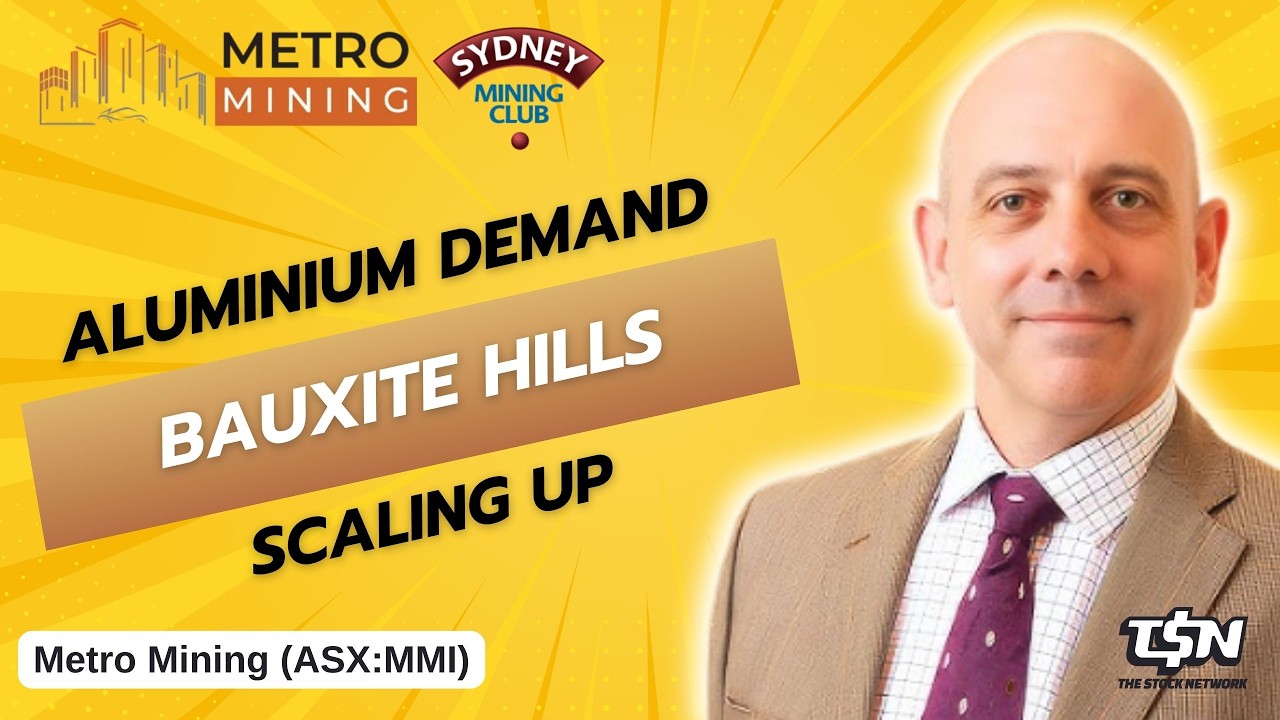
Transcription of The Stock Network Interview with Metro Mining (ASX:MMI), CEO and Managing Director, Simon Wensley
Lel Smits: Metro Mining is building its position as a key supplier to the global aluminium industry through its flagship bauxite hills mine in Cape York, Queensland. With strong reserves, established operations and growing shipment capacity, the company is focused on supplying China’s expanding bauxite market as aluminium demand rises alongside the global energy transition. Ahead of presenting at Sydney Mining Club, I’m joined by Metro Mining CEO and Managing Director Simon Wensley to discuss the company’s long-term growth strategy, operational scale, and also the outlook for global bauxite demand.
Simon, welcome to the Stock Network.
Simon Wensley: Great. Yeah, thanks for the invitation. Great to be here.
Lel Smits: Now, aluminium is becoming increasingly important across infrastructure, energy and manufacturing. How is Metro Mining positioning itself to benefit from long-term growth in global aluminium demand?
Simon Wensley: Yeah, that’s right.
It’s certainly one of the most important energy transition metals. We’re seeing huge growth out of things like electrical networks, electric vehicles, and other transportation batteries. And indeed, alongside copper and some of the other metals, it’s seeing huge growth alongside its traditional uses in construction and food packaging, etc.
So, look, bauxite is effectively the upstream ore for making aluminium. There’s no other way to make primary aluminium. And primary aluminium, even with increased recycling rates, which of course we support and is one of the important parts of aluminium demand, primary aluminium from a quality perspective is still going to be needed for a lot of applications.
So, we’re positioning ourselves as a very reliable and low-cost supplier into that market. The Asia-Pacific is where a lot of the growth is happening in that market. And of course, that means that out of Northern Australia, where our mine is, we’re extremely well-positioned for that growth.
Lel Smits: Excellent. And Simon, Bauxite Hills has been operating since 2018 and continues to expand shipment capacity. What are the key priorities for growing production and also strengthening Metro’s position as a reliable bauxite supplier?
Simon Wensley: Yeah, so we’ve grown production sort of from coming out of COVID, which was a difficult period.
From 2021, we were running at about a 2 million tonne run rate. Our target this year is 7 million tonnes. So, that’s been our strategic target since we announced the expansion of the operation in 2022.
So look, that underpins not only obviously increased revenue from volume, but also economies of scale from our cost structure. And I think that’s one of the key aspects for any investor here is that, along with increased growth from volume comes decreased costs. And that’s an absolutely critical part of any bulk commodity in terms of being well-positioned on the cost curve so that you can withstand what is always likely to be a cyclical market.
And so, look, we’re aiming effectively to be the lowest cost supplier into that Asia-Pacific market. It’s a challenge, but we’re certainly on track for that and aiming to try and get most of the way there this year.
Lel Smits: Simon, I appreciate the update on Metro mining. Look forward to hearing more when you’re on stage at Sydney Mining Club this week.
Simon Wensley: Yes, I’m really excited about coming to speak at Sydney Mining Club, obviously talking about bauxite, which is sort of maybe a little bit under the radar, but it’s certainly the sexy part of that value chain in terms of upstream margins and where rent accrues in that value chain. Also talking about our operating model, it’s low cost, it’s scalable, and we use some pretty innovative technology in the trans-shipping space, which is sort of quite rare, certainly in Australia.
And also talking a bit more about market evolution, how Guinea from West Africa is trying to become the OPEC of the bauxite market and how Metro in that context is actually maybe a play for those looking to take advantage of high oil prices. So I’ll explain all of that in my presentation.
Lel Smits: I’m sure you will have a full crowd there ready to watch you.
Simon Wensley: Great. Yeah, I hope so too, and I really look forward to it.
Ends