
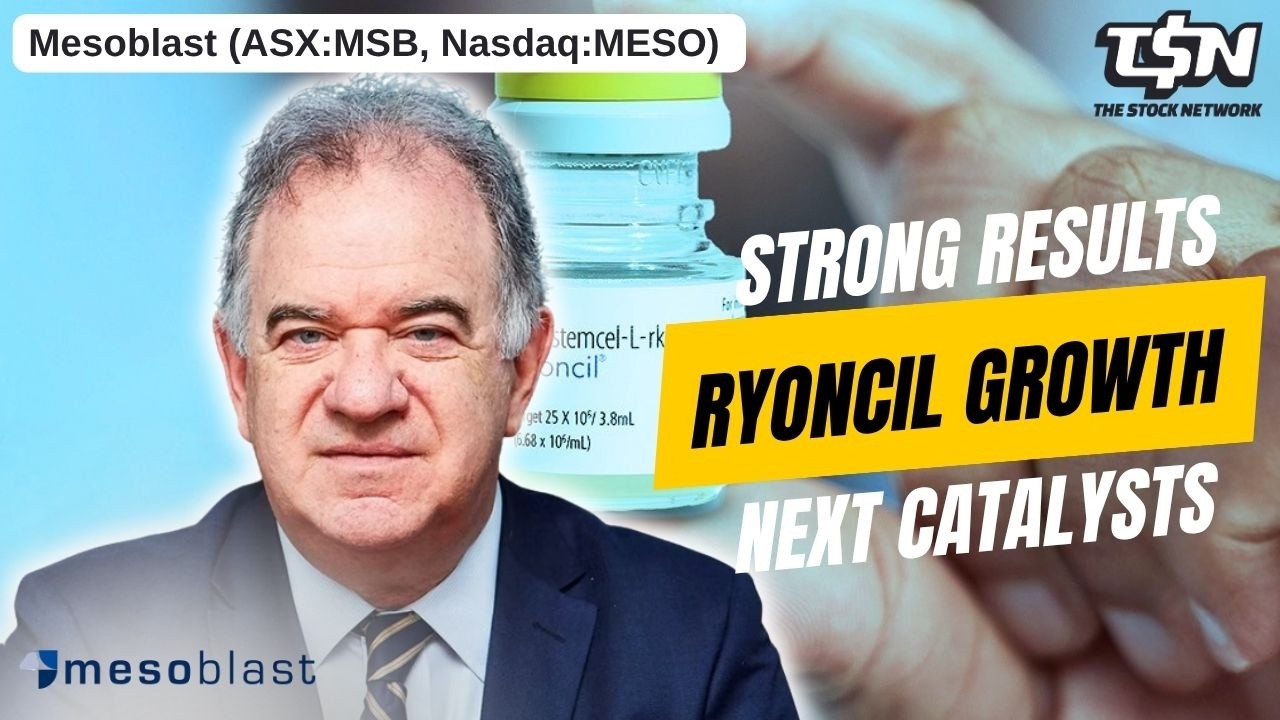
Transcription of The Stock Network Interview with Mesoblast (ASX:MSB, Nasdaq:MESO), CEO and Managing Director Dr Silviu Itescu
Lel Smits: Mesoblast has delivered a strong FY26 result, with Ryan Seale driving a major lift in revenue and the company moving closer to a sustainable commercial model. At the same time, cash discipline has improved, while Mesoblast continues to invest in its pipeline and next phase of growth. With Ryan Seale gaining traction, plans to expand into the adult market, and its Phase 3 chronic low back pain trial complete, Mesoblast is entering its next stage of growth.
I’m joined today by its CEO and Managing Director, Dr Silviu Etescu, to discuss the results, Ryan Seale growth and the key catalysts ahead. Silviu, welcome back to the Stock Network.
Silviu Itescu: Thanks. Good to be here.
Lel Smits: Now, you’ve just released your full year results for the 2026 financial year. Can you talk us through your highlights?
Silviu Itescu: Sure. We had a very strong financial year result. We reported US$120 million in revenue. We reported that we had US$103 million in cash.
Our operating cash spend for the last half was only about US$13 million, so we’ve got very good tight controls now over our spend. And we’ve got some pretty exciting near-term and mid-term milestones to talk about.
Lel Smits: Absolutely. And on those milestones, look, Ryan Seale generated US$115.2 million in net revenue with more than 50 US sites onboarded, and coverage now reaching more than 280 million people. What’s driving this growth? And also, how do you plan to keep the momentum going?
Silviu Itescu: Our commercial team is in place and is doing a great job. We’ve got Medicaid coverage federally across the US and mandated in every state.
We had a J-code in October, which means there’s pricing for every unit that’s sold that’s in place that hospitals can access. And the vast majority of commercial carriers all reimburse our product. So we’re covered by insurance with no step-throughs, with no deductions.
And it’s all about building penetration and optimising adoption. And so we’ve got a clear strategy in place about how Ryan Seale is going to be used by more and more sites and by more physicians as early as possible. These are children with very bad disease called graft-versus-host disease, and as soon as steroids fail, they ought to be using our product, Ryan Seale.
There’s a lot of potential for further growth as physicians are comfortable with prescribing it and as more hospitals get onboarded. I would say that today we’ve probably penetrated about 20% of the addressable market. So we have strategies in place to grow that pretty aggressively in the next 12 months.
Lel Smits: And Silviu, when it comes to unlocking the adult market, you’re progressing, Ryan Seale, into adults with severe steroid refractory acute graft-versus-host disease, a market which is three times larger than the paediatric market. How significant do you think this expansion could be? And also, what are your near-term priorities here?
Silviu Itescu: That’s right. This is a huge short-term growth opportunity for us.
There is one drug that’s approved for adults with this devastating disease and it’s called roxalipinib. It works reasonably well in mild disease, but in the 50% of patients, adults with what’s called grade 3, 4 disease, roxalipinib doesn’t work quite that well. It doesn’t demonstrate a survival benefit, and only about 50% of patients respond to the drug.
So that is the area that we’re focusing on. And in the first instance, we’re in a phase 3 trial, a randomized control trial, of about 180 patients, targeting that severe population with grade 3, 4 disease in adults, and we’re comparing roxalipinib alone versus roxalipinib plus our cells. And if successful, we would be part of the standard second-line regimen for adults who fail steroids with this severe disease.
In addition to that, today, patients who receive roxalipinib and fail have really nothing else. And that’s, as I said, 50% of adults with bad disease don’t respond to roxalipinib. Once they fail that drug, their likelihood of being alive 100 days later is no more than 25%.
In our compassionate care program, we’ve treated 53 patients with bryoncil, and in those patients, we see about a 65% to 75% survival at day 100. In fact, in the adolescents and adults, we saw 76% survival at day 100, which is tremendous compared to the 25% in the literature for those same patients treated with other agents. So right now, bryoncil is available, and in fact, in some cases, insurance has paid for bryoncil in these desperate patients once they’ve failed roxalipinib and have no other options.
So those are two overlapping markets, early in second line and at the end of once they’ve failed roxalipinib as third line. And so our strategy is to work with the FDA, and hopefully our phase three trial will succeed and give us label extension and approval. There will be an interim analysis for that trial after 100 patients are enrolled, which will be later in 2027.
Lel Smits: And Silviu, finally looking more broadly at your catalyst, the phase three chronic low back pain trial has completed the treatment of 350 patients with the results expected mid next year. You’re also advancing the heart failure and next generation programs. Which upcoming milestones do you think are going to have the biggest impact on mesoblast?
Silviu Itescu: Our second generation platform is called Rex Lemi StroCell.
That’s being developed for the blockbuster indications of back pain, inflammatory back pain and inflammatory heart failure. We’re very excited about the inflammatory back pain opportunity. It’s an addressable market north of 10 billion.
And we’ve completed one phase three trial, which demonstrated a significant pain reduction for anywhere from 12 to 36 months from one injection. And this final pivotal phase three trial has just completed 350 patients treated, a randomized controlled trial against placebo. We originally were looking to enroll 300 patients, but we’ve enrolled 350 because of the tremendous demand for getting patients enrolled in this trial by physicians, which tells you a lot about how they see this innovative trial, the innovative product, and the unmet need.
There just isn’t anything out there. In any event, we’ve completed 350 patients treated, and we’re following all these patients for up to 12 months. The readout will be in the middle of next year.
And if positive, we will move forward rapidly with a filing for potential approval in 2028 for this product that represents, as I said earlier, a total addressable market of at least 10 billion plus in the US. And we retained full value of the asset in the US market for the company.
Lel Smits: Silviu, thank you for the update on Mesoblast and congratulations on your results.
Silviu Itescu: Thank you for your time.
Ends