
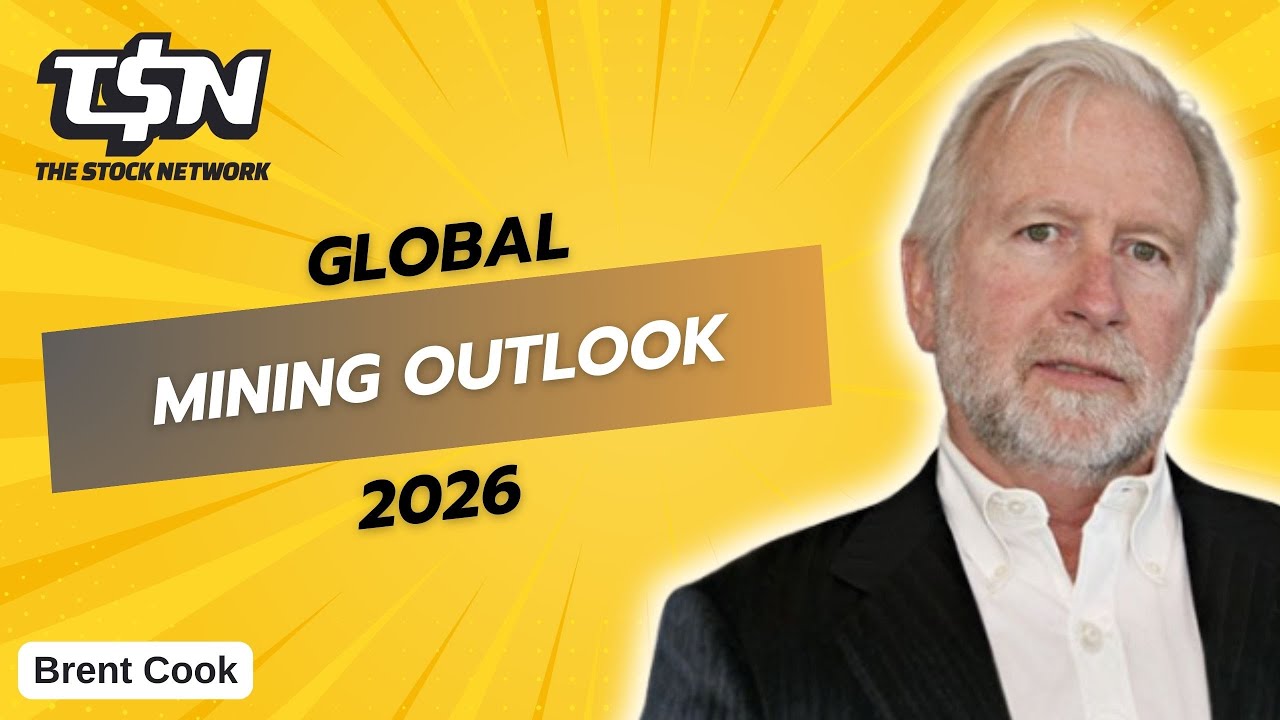
Transcription of The Stock Network Interview with Brent Cook, Renowned Exploration Analyst and Economic Geologist
Lel Smits: Brent Cook is a renowned exploration analyst and economic geologist with more than 40 years of experience in mineral exploration, mining and related financial sectors. Having worked in more than 60 countries and in virtually all geological environments, Brent has been and remains a highly respected consultant to various funds, major mining companies and junior explorers. And I’m joined today by Brent to discuss how shifting exploration appetite among major miners may shape the next phase of the commodity cycle and also how he’s seeing the resource market, particularly from a North American perspective.
Brent, welcome to the Stock Network.
Brent Cook: Well, thank you. It’s glad to be on.
Lel Smits: Now, you’re based in the U.S. and you have a truly global perspective as an explorationalist also from an allocation of capital perspective, also probably better known in the North American markets than Australian. Could you provide us with a brief background on yourself?
Brent Cook: Sure. I guess I did live in Australia for six years, worked mostly up in North Queensland, up into Papua New Guinea and just, you know, I love the country.
I wish I’d stayed there in some respects. But anyway, I was doing minerals exploration globally up until 1997, at which point I ran into Rick Rule just as the stock market was collapsing, BREEX and all that. And he put me on as his analyst.
And that got me a better, much better understanding of the money side of things, which is way different than being a geologist out mapping rocks and coming up with ideas, because now you had to see how it made money. So that lasted, I think I was there four or five years. Then I went independent, consulted with a number of major mining companies, some funds, and traveled.
You know, I’ve been to like 70 countries now looking at rocks. Started a newsletter called Exploration Insights, which I sold to a smarter geologist than me, Joe Mazumdar. So he’s running Exploration Insights right now.
And I’m just advising a few funds and managing my own money. And I’ve gone on as an advisor to a few companies. You clearly know this space inside out.
And I’m interested to hear when it comes to the mining cycle, where you see us really in terms of the mining cycle from a public market investor perspective and also from the exploration and discovery cycle from within the industry. With the caveat that this is the craziest world I’ve seen politically, particularly emanating from here in the U.S., assuming that doesn’t blow up, I think we’re probably midway through a solid metals bull market for a number of reasons I’m sure you’ve discussed. I think that what we’re going to see happening now is a lot more companies being listed and being listed on projects that have, let’s say, failed numerous times in the past.
So as someone speculating in this sector, either here or Australia, you need a much better handle on what the background of each project is, the history, and what the potential really might be. Absolutely. And when we look at that space, are there any mineral districts or commodities that you’re currently focusing your attention on? Also, maybe that you think investors should be keeping an eye out for? Well, certainly Gold, Copper, Silver, Uranium, and Rare Earths.
That’s where I’m focusing. Okay. Districts.
The Andes are always great. Western U.S., Nevada, Idaho, Utah, and Arizona in particular. Australia is always a great place to be.
And I think on the up and coming side of things, Argentina, Bolivia, and even New Zealand are becoming more prospective in terms of the ability to actually explore and do something.
Lel Smits: That’s certainly a big list. And look, Brent, I also wanted to ask your opinion on an exploration model that’s more common in North America than in Australia, particularly given your long background with the majors to juniors.
How do you assess the role and relevance of prospect generator models, particularly in the current market? And also as a follow-on, do you have any insights as to why this model isn’t so common in Australia?
Brent Cook: Well, I think what one has to realize is that getting harder and harder to make an economic discovery. Most of what we’re looking for now is blind, basically undercover. So you don’t have that physical rocks at surface that you’re looking for.
So it’s essentially, if you’re drilling for, call it a porphyry copper, and you’re drilling through one, two, 300 meters of post mineral material, those drill holes are essentially what used to be rock chip samples you do at surface. So it’s much, much more expensive just to get your basic information before you actually get a target. And the advantage with the prospect generator model is that the people that put the ideas together, they have to sell these concepts to a major mining company who has money to allocate, but they’re only going to allocate it to projects that they feel, if they’re successful, would be big enough to make important to their financial conditions, their profits and such.
So by bringing in a major, the cost of all the work to get to actually finding a prospect to drill, it can be tens of millions of dollars easy. That is covered by the incoming partner. And in Australia, you see that happening with Concora.
They brought in Anglo to look for porphyries in the Macquarie Arc. And they’re basically drilling through, you know, hundreds of meters of blind cover looking for another Katie Ridgeway, which is going to take tens of million dollars to get to the point where you can say, we think we’re onto something. So I think that’s the big advantage.
You’re diluted at the property stage where your risk is considerably higher. Whereas you’re not diluted as much at the shareholder level, where if you make it successful, even though you’re not, don’t under a hundred percent, the share structure ensures outstanding, you get a much bigger boost and you don’t go broke. I mean, it’s going to take, you know, five, six, 10 projects to evaluate before you actually come across the discovery.
Lel Smits: Yes. And finally, Brent, can you provide some insight as to where you’re focusing your time and investing your capital in the current market?
Brent Cook: Well, I do own some prospect generators. In fact, I’m an advisor to Kincora.
They’re in the Macquarie Belt to Headwater Gold in Nevada and Idaho and Homeland Uranium, which is looking for uranium in Western Colorado, an area I worked my first job at a university. So those, that’s where I’m putting some time. I’m looking at rare earths in terms of in Brazil, there’s some great companies doing work there.
And in fact, Clara is one that I own, I think is doing well. In Arizona, there’s Arizona Sonora Copper, which has a great deposit. They’re going to produce cathode on site in the US.
So that’s kind of where I’m focusing.
Lel Smits: Well, it has been wonderful to catch up today and certainly an exciting outlook for the mining sector in the year ahead.
Brent Cook: Well, thank you. I appreciate the invitation.
Ends