
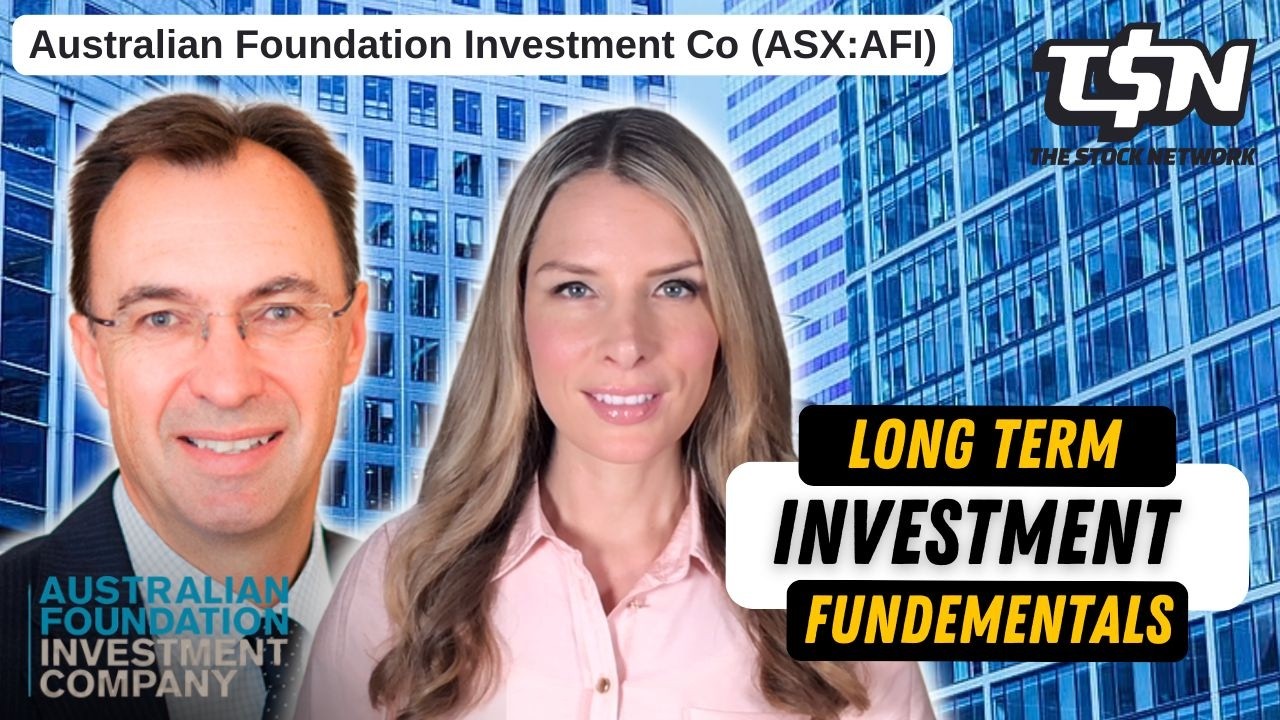
Transcription of The Stock Network Interview with Australian Foundation Investment Co (ASX:AFI), CEO Mark Freeman
Lel Smits: Australian Foundation Investment Company, or AFIC for short, is one of Australia’s largest and oldest listed investment companies. Its origins can be traced back nearly 100 years to 1928 and manages a diversified portfolio of Australian and New Zealand equities with a focus on delivering long-term capital growth and tax-effective fully-franked dividends to its shareholders across economic cycles. Its investment style is to buy shares in quality listed companies and hold them for the medium to long term.
I’m joined today by CEO Mark Freeman to discuss AFIC’s investment philosophy, how the company is navigating market volatility and the competitive threat of dividend ETFs. Mark, welcome to the Stock Network.
Mark Freeman: It’s a pleasure to be here.
Lel Smits: Pleasure to have you on. And I’m keen to understand AFIC, it’s been investing in Australian and New Zealand companies for almost a century, but what do you think really sets your stock selection process apart and how has it coped with the reduced dividend yields that are really the norm in Australia and New Zealand stock markets?
Mark Freeman: Yeah, I guess given the unusual structure being a listed company, we don’t have inflows and outflows that the capital’s fixed. And I guess it’s being able to take that truly long-term view of the business.
So in that sense, we’re more about investing in a company rather than trying to trade a share price. So we’re not traders, we’re just looking for businesses that we think can be around for the long term, solid companies that are well run. And then we look for opportunities to buy them at sensible prices and we’re happy to hold them over the long term.
There’s a lot more volatility in the market these days, but that’s really the core of what we’ve been able to do is take that longer term view of the company and be patient when we buy them.
Lel Smits: Yes. Now on that long-term view, you’ve obviously been around for a long time and you stress the long-term view, but I’m also curious to hear how you really approach short-term issues.
For example, the current Middle East conflict is really showing no signs of letting up and we’ve also had other geopolitical events like Ukraine and Russia that remain unresolved. How do these events really and their ramifications for economic growth expectations, how are they impacting your investment strategy and adjustments to your stock portfolio?
Mark Freeman: Yeah, well look, I mean these are all building on each other, but there’s kind of this sort of relationship between stock markets, businesses and valuations and where we are in terms of the number of events or lack of events and they kind of end up being connected in the long run in terms of what you get out of the share market. And so we’ve been sort of more cautious on the market because when you look at long-term valuation metrics, whether it’s the Australian market, the US or pick your market and whether it’s price to sales or price to book, or as you point out, dividend yields are very low.
Now often dividend yields are low because share prices are high. If share prices came back, dividends would be higher. And so they all point to markets as trading on, by historical standards, pretty high valuations.
And so we’re cautious. So often when you get these global events, the impact it can have on the share market is often linked to where the valuation. So if valuations were, if we were sitting here and the stock market was really low, they would probably have a smaller impact.
But if valuations are high on the stocks, these sort of events can have quite a significant impact and you’re really starting to see it play out in markets at the moment. Because the other thing that’s coming into play, it’s not just that, it’s AI. So the people’s perception of what AI is going to do to certain sectors like software, it’s now sort of leaking into insurance and technology more broadly.
Any company that relies on data, they are being hit hard. And so then you get the events, war in the Middle East, that creates uncertainty. We’re seeing some companies starting to cut jobs because of AI, so people worry about unemployment.
So you’re getting this layering effect of bad news on a stock market that’s had a high valuation. And it’s starting to sort of creep through into the share market. And so historically, what we do is these bad events, if they play out or they continue to play out, ultimately you’ll start to get more attractive prices for stocks.
So we start to think about, well, what are the companies that we like for the long-term and when are we going to start getting some prices that we think are really cheap? Because part of the secret for doing well in the stock market is finding which are the good companies, but then reserve your buying until you get really opportunistic prices. And the best time to be opportunistic is in the face of really bad news. And when you can look through the market and say, I can see these valuations are really cheap.
Lel Smits: Absolutely. And separately, when it comes to AFIC versus dividend ETFs, ETFs, of course, have become the investment vehicle of choice for many Australian investors of late. What does AFIC offer that makes investing in its shares more attractive, do you think, than an investment in the growing number of dividend ETFs holding high yield, also income producing companies?
Mark Freeman: Yeah, so I guess it probably goes back again to the company structure.
We tend to pass through the dividends we receive from our investments to shareholders. So you get that dividend yield. But we, from time to time, might take capital gains.
We’ve got to pay tax. That produces a franking credit. And we can use that to pay dividends as well.
But we don’t have to pay them out immediately. So we can sort of distribute those over time. And we tend to keep a bit of a bank, a bit of a supply of franking credits.
And when we’ve been through tough times in the market, like COVID, we were able to draw on those reserves and sustain our dividend through the tough times. That’s something that an ETF can’t do. And we know our shareholders really appreciate that, the fact that sustaining a tough time is really important.
And at the moment, we’ve been able to pay special dividends on top of our ordinary dividends because of the capital gains we’ve been making. And so the yield across our LOCs is really quite attractive at the moment because we’ve been trading at a discount to NTAs, which has happened before. And it tends to happen when you’ve got a hot market.
So around the tech boom in 2000, everyone was chasing tech stocks. So we tended to trade at a discount to our NTA or fair value. During the lead up to the GFC, we went to a discount.
But when those markets collapsed, we went back to being at a premium. So what we tend to find is when markets fall, our share price tends to be pretty stable. So at the moment, we’re probably trading at at least 10% below fair value.
So you’ve got that buffer, but you’re getting a yield on it, a share price that’s at a discount. So the yields are extremely high when you include franking credits across our funds. You know, in the past, we’ve provided stability to it.
So there’s a few things that come into play. The other thing about our funds is that there’s no external manager. So there’s no fee going to an external pay.
There’s no performance fees. So if you look at our large Australian foundation, the cost to investors is about 0.15%. So it’s not that far from an ETF. So we would see ourselves and our funds as kind of equivalent to an ETF.
Low cost, no performance fees. But there’d be a time and a place when you looked at either one. At the moment, because we’re trading at such a big discount, we’re biased, but we think there’s value in buying our stocks because of the high yields.
But occasionally, we do trade at a premium. And then it might be a different story. But as we stand at the moment, we’re at a discount, so you can buy a dollar’s worth of assets for 90 cents.
Lel Smits: Well, I appreciate the update to Australian Foundation Investment and also look forward to seeing how your investments will be positioned in the year ahead in light of everything that is happening in the macro environment.
Mark Freeman: And there’s a lot going on.
Lel Smits: There certainly is.
Mark Freeman: Thank you so much. That’s a pleasure.
Ends