

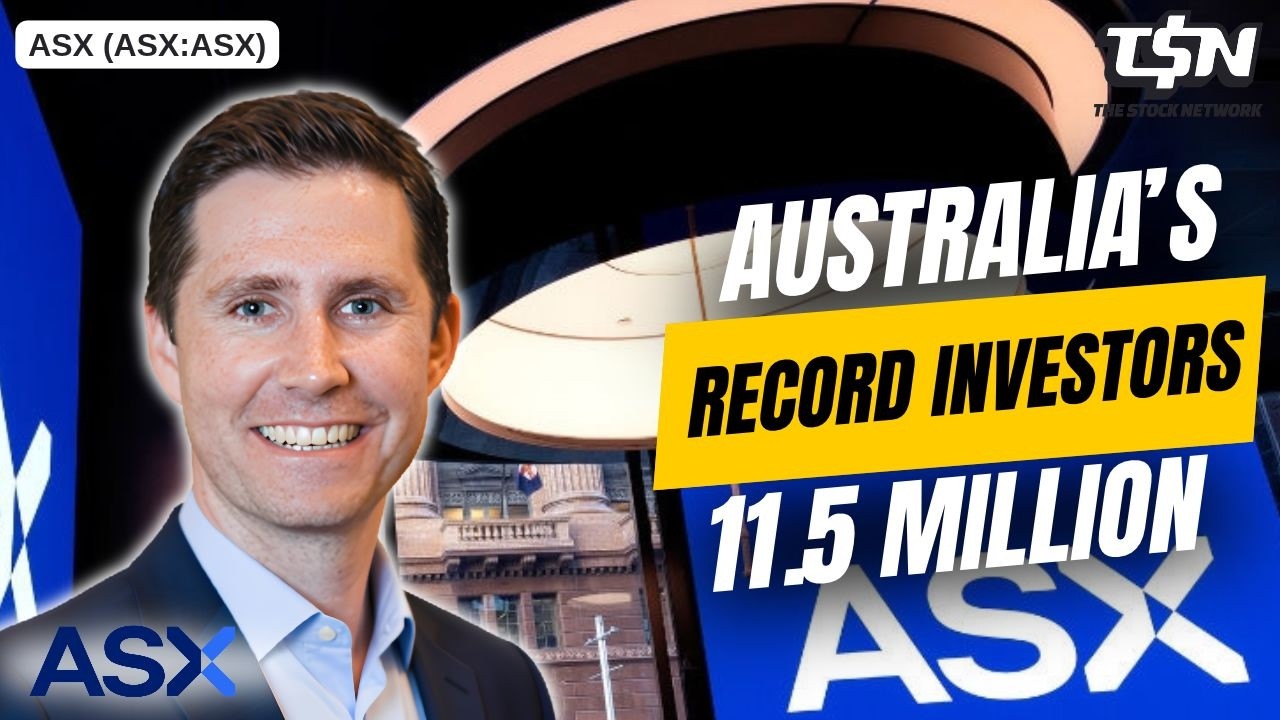
Transcription of The Stock Network Interview with ASX, Senior Manager of Investment Products Rory Cunningham
Lel Smits: ASX’s latest Australian investor study shows a record 11.5 million Australians now invest outside super and the family home. ETF ownership has more than doubled since 2020 to 2.82 million investors. And among investors under 30, an ETF is now as common as a first investment as an investment property.
Following the launch of the study, I’m joined by Rory Cunningham, Senior Manager Investment Products at ASX, to unpack who Australia’s new investors are, why so many are starting with ETFs, and what first-time investors should understand before they buy.
Rory, welcome to The Stock Network.
Rory Cunningham: Thank you, very good to be here.
Lel Smits: Now, Rory, I’m keen to understand who Australia’s new investors are. The study shows a record 11.5 million Australians now invest outside super and the family home. And the next wave is younger and more female than ever.
What’s driving that shift? And also, can you outline for us what surprised you personally most in this year’s findings?
Rory Cunningham: Yeah, the findings are very important, I think, for Australia. We have more investors since 2020 that have entered the market, two and a half million new investors. Strong growth from younger investors in particular, next generation investors make up a large proportion of those new investors.
And then in terms of intending investors, something very important that you mentioned was the number of intending female investors. And there’s over close to a million investors now that intend to invest. 60% of those are female investors, which is incredibly positive.
The question is, what’s driving the growth of new investors? It’s a number of things, to be honest. There’s no silver bullet, there’s no one thing. We’ve seen an increase in different education platforms to retail investors, which has been incredibly powerful at helping investors understand how to access the market, how to build a quality portfolio, how to build a diversified portfolio.
We’ve seen a growth in ETFs and ETFs have made investing very simple. We’ve also seen the cost of investing come down over the last number of years. So I think all these factors combined, they’re helping to drive the growth of Australian investors.
And for investors under 30, an ETF is now as common as a first investment as residential property and a third of people planning to start investing say that ETFs are likely to be their first move. Back in 2020 to Rory, you wrote that younger investors were bypassing shares in favour of ETFs. Why do you think that trend has accelerated? And what do you think a first-time ETF investor should really understand before they buy? So we’ve seen incredible growth in the ETF market.
There’s now well over 400 ETFs that are listed on the ASX. Our market cap is approaching $400 billion of assets. So that’s $400 billion of Australia’s capital that is sitting in the ETF market.
And that’s forecast to grow to somewhere around the vicinity of a trillion dollars by the end of 2030. So without a doubt ETFs are going to play a really important role in helping everyday Australians reach their financial objectives. Now the question is why investors adopting ETFs? There’s a few things in that.
First of all is the simplicity. Investors are very used to or particularly used to buying a share through their broker on the ASX. An ETF is the same experience.
An investor can log into their broking account, choose an ETF and buy at that moment on the ASX. So it makes the process of investing very simple. ETFs as well are typically very low priced.
A lot of ETFs are tracking and index. They’re what we call index tracking vehicles. So tracking very common benchmarks or markets that we see every day in the news.
Things like the S&P ASX 200 index. Perhaps it’s the US market like the S&P 500 index. And these products, these ETFs that track these markets are very attractively priced.
So that’s point number three. And then I suppose point number three is around diversification. Through one trade at a very low cost investors get access to hundreds if not thousands of underlying securities, helping them build a diversified portfolio.
Lel Smits: Wonderful. Okay now Rory when it comes to income, steady income, 73% of investors said in the report that they now prefer guaranteed or stable returns and building a sustainable income stream is their top goal. Even the under 30s are most likely of any age group to want stability.
How are listed products really like fixed income ETFs, bonds and LICs, listed investment companies, meeting that demand from your perspective?
Rory Cunningham: Yeah it was a really interesting result of the survey. Just how conservative Australian investors may be becoming. And as you’ve highlighted we’ve seen an increase in I suppose the desire for investors to build a portfolio that is relatively conservative.
If that is the desire of an investor then typically what they’re going to be looking for are underlying assets or investment strategies that are also quite conservative. So building a sustainable income stream or a stable relative return for them. The fixed income asset class as you point out is one way to do that.
So we have seen and particularly now that we’re in a rising interest rate environment, we’ve seen more ETFs come onto the ASX, more listed investment companies and trusts come onto the ASX that provide investors with exposure to fixed income asset class. That asset class by its nature is relatively stable, it provides an income stream to investors and if that’s what investors are looking for then it’s helping to achieve their objective.
Lel Smits: Okay and Rory when it comes to crypto it’s going mainstream.
Almost 2.8 million Australians hold or trade crypto, yet ASX listed crypto products hold about 524 million dollars. What do you think is behind that gap and also where do listed crypto products fit in for crypto investors?
Rory Cunningham: I think one of the interesting results of the survey and this is the second survey in a row that we’ve measured how investors are investing in crypto assets. Crypto assets still make up a relatively small proportion of an investor’s portfolio.
So what I would say is that investors while the number is large they do appear to be dabbling in crypto assets as opposed to making a significant investment as part of their overall portfolio in crypto assets. So I think that’s one caveat to consider when looking at this. On the ASX we do have ETFs that track Bitcoin and Ethereum but as we know there are many crypto assets out there.
We don’t have ETFs that cover those asset classes yet so for investors that are looking to get exposure to a broader range of crypto assets typically they have to go to different platforms and overseas platforms in order to access those those crypto assets.
Lel Smits: Yes and finally Rory, just over half of people planning to invest say that they’ll start once they know more. Under 30s now say they get investment advice from AI more often than from a financial planner.
What do you think is the biggest mistake that you see first-time investors make and also where do you think they should go to build their confidence?
Rory Cunningham: A very personal question there. I think in terms of the biggest mistake that investors make and I’m very biased here but I think it’s not starting early enough. I think investors in my personal experience put themselves under a lot of pressure to have to know too much before they start investing.
The process of investing is very simple. All you need is a mobile phone and a relatively small investment balance in order to invest in a product that could be an ETF or that could be a share. You don’t need to know everything before you start your investing journey.
You can start small and build up your exposure over time as you learn and as we all know the power of compounding interest makes it really important for younger investors in particular to get started and then to learn as we go.
Lel Smits: Rory Cunningham, thank you for taking us through ASX’s latest Australian investor study and look forward to seeing how the data unfolds.
Rory Cunningham: Thanks.
Ends