
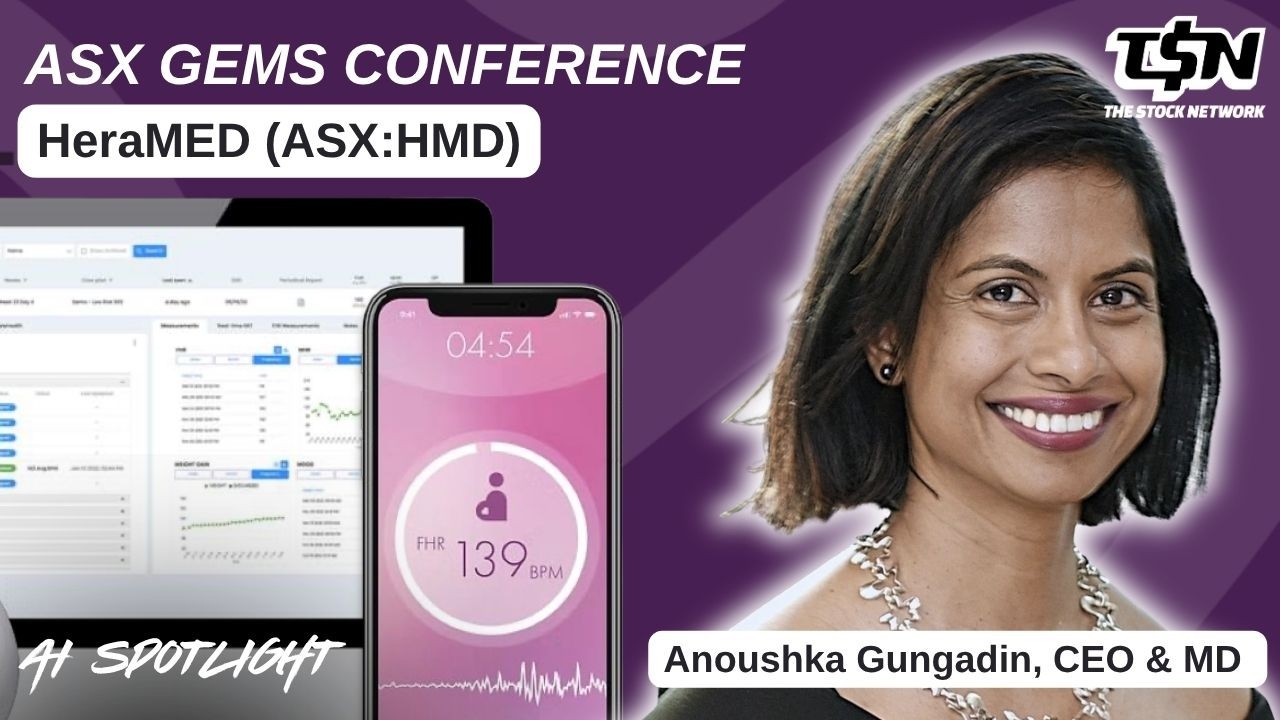
Transcription of The Stock Network Interview with HeraMED (ASX:HMD), CEO & MD Anoushka Gungadin
Anoushka Gungadin: Hi everyone, my name is Anoushka, I’m the CEO and Managing Director of Heramed. I am delighted to be here and to tell you a bit about the work we are doing at Heramed. I’ll get you to read this and I will keep continuing.
Heramed is working in the space of women’s health, starting with maternity and pregnancy. We started our life as a hardware company and then we extended to have a software platform and today we’re also integrating data and AI into the solution. But the problem we’re solving is still maternity.
Why? Because in the US and around the world, 82% of maternity-related deaths can be prevented. One in four women are not receiving enough care and again, those are things we want to change. The way we’re doing this at Heramed is through our hardware, which is our own proprietary fetal heart rate monitor.
The FDA and TGA-cleared at-home use fetal heart rate monitor. To support that, we also have a very user-friendly companion app for the women and a clinician dashboard that sits within the hospital system. Our product is designed around the women, however, it is also very much in line with what hospitals’ workflow and protocols look like.
Today, we’re also embedding data-related capabilities and AI into the solution we are offering. As a result of this, we can provide care to women where they are, when they need it, as opposed to a hospital-centric model. We continue to have visibility in between visits.
We are able to detect risks and complications earlier than in normal settings and we are also able to scale this solution and bring it to women who are not able to otherwise access care. I’ll spend a second on this. I wanted to highlight our commercial team that’s sitting in the US.
Healthcare veterans who have built and sold companies within the health system, who are providers, who are also from payer networks. We’ve got the whole spectrum covered with our healthcare team in the US. Now, coming back to the maternity problem.
It’s a 100-year-old model of care. We haven’t changed the way we deliver care. The way I would be receiving maternity care and visits through my pregnancy is the same like our grandmas used to, and time has changed.
Not only that, there is a big problem in terms of access. There’s not enough workforce being able to provide this care to the growing number of women. Affordability of care is becoming less and less affordable and more expensive, and certainly we know the burnout as well within the hospital system.
If we look at the US system, 35% of the US does not have even one maternity clinic. Everything you see in that pink colour is what we call maternity desert. In fact, it used to be one in four counties that didn’t have a maternity clinic.
Now, it’s one in three. It’s getting worse, yet we’re still spending a lot of money on it. The way HERiMed is solving this, it’s in combination of our own proprietary fetal heart rate monitor, as well as a number of other vitals that we are able to capture through our system.
With new thinking, any vitals that a woman needs to be measured and monitored through a pregnancy, blood pressure, glucose monitoring, as well as a number of assessment-based surveys, such as social determinants of health or the depression score, all of those data points are captured through the platform. We connect seamlessly into cellular devices, as well as Bluetooth devices. Those data points, along with educational content, are customised into personalised care plans, and those care plans are customised based on a woman, on her pregnancy conditions, on her gestational age.
As a result of that, she goes home from the hospital with a kit based on what she needs, as well as a care plan that will have tasks for her to do every day, that will have educational content for her, that will also have escalation of care that sits within her app at home. Essentially, she has her doctor in her phone, and that information is seamlessly available and transferred to her care team. We work with the hospital system to take the existing protocol, using technology to create a care plan that can continue to monitor women in between visits, in between touch points.
That’s on the woman’s side, it’s a very user-friendly companion app, and then on the provider side, it’s a clinical dashboard that integrates into their existing EMRs. Often, hospital systems are using Epic or Cerner, Athena, a number of different EMRs. We seamlessly integrate into those as well.
So, if you think of a solution that is women-centric, based on the woman and her needs, but at the same time, very much integrating into the day-to-day clinical workflow, that’s what HeraCare does. Today, we’ve also used a number of data points that we are collecting, AI capability to provide more AI capability on the woman’s side in terms of a companion app, and on the provider side, we have AI-powered insights looking at the data points that are coming in, any escalation that needs to be flagged for the clinicians, ambient scribing, all of those already sits within the platform. That was the view of the patient, this is how it looks like from the HeraCare clinician dashboard.
A number of data points come in, we use our AI studio then to design those care plans, based on the woman’s condition, dashboard to be reporting on the monitoring that’s happening, and a number of different reporting on analytics, be it clinical or operational. I have covered this. Women absolutely love the experience with the HeraCare platform.
This is consistent across all the women that we have been working with and surveying, be it in the US or in Australia, a very high NPS score. On the clinician side, we are seeing outcomes both in terms of maternal and fetal care delivery improvements, as well as financial outcomes. We are approaching 0% postpartum readmission, for instance.
Preterm birth has significantly decreased, and we’re talking about very vulnerable population. It works there, high-risk pregnancies as it does in low-risk pregnancies as well. We can identify complications such as preeclampsia very early in the piece.
Unexpected ED visits are reduced, so your emergency is not getting bogged down with visits that can actually be done over a phone or through the app. As a result of this, we have seen improvement in clinicians’ productivity between 33% and 46%. This means you have more time to be seeing other patients or doing other tasks, and yet the level of care and support that the woman requires is still being delivered through this hybrid model.
I will spend a little bit of time on Leigh Health, which is one of the large health systems in Florida, digitally very mature and epic shop. We have just finished six months of phase one launch with Leigh Health, and again, very much consistent with what we have seen before. High patient engagement and satisfaction, as well as clinician satisfaction in terms of how they’re able to support their patients.
There’s been meaningful capacity uplift with additional prenatal visits being freed up for new patients. At the same time, there’s a significant productivity gain as well, both in terms of clinical capacity, more appointments made for new patients, and a hybrid model whereby a number of unnecessary visits were avoided, early detections of complications happened. The next phase of this is where we are now, looking at both an integration into their epic system, as well as expanding the number of patients into a full rollout.
This is what we’re working on at the moment with Leigh Health, so very, very exciting times for us in terms of this site. Another spotlight on Philips. Philips is our channel to market partner in the US.
Through Philips, we are bringing our technology platform along with their sales network and hospital networks, and together we are approaching the maternity market. Through Philips, we are also able to look at the $50 billion rural health transformation funding that came out this year in the US. Each state is having about $200 million a year over the next five years on rural health and maternity health, remote patient monitoring absolutely falls very much into that bucket.
With the rollout, with Leigh Health, the partnerships with Philips, this funding, along with our growing direct sales pipeline, this is really the picture of what we are painting and working on in the US. The future for us, starting in pregnancy and 12-month postpartum is now expanding to be able to support the woman across her life stages. From a hospital provider perspective, they do not need to be having a number of different siloed and fragmented care, which has been very much how women’s health has been delivered so far.
We want to have a system that is bridging each of these stages, a system that talks to each of these stages, a place where information you collect in one stage of life can actually help prevent complications into the future. You look at pregnancy, we have care plans around hypertension, gestational diabetes, and mental health, all of three key buckets of chronic care issues later in life for the woman. Data shows pregnancy health is actually a big indication into later life health for women.
With what we are doing, we’re able to collect information and provide that to our clinical care partners, who then are able to go into prevention rather than having an episode where a woman is coming in, in absolute emergency. So that’s where the future is for us, expanding from maternity into midlife, chronic care, those are the two we’re going in next. This is what the next six months looks like at Heramed.
We have finished the phase one at Leigh Health. We’re working on the next stage of that partnership. We will be onboarding patients.
We also will be working with Philips to expand that partnership and actually convert and deploy in first hospital with Philips, and we continue to advance our pipeline in the US. I will stop here, but look forward to having any questions answered directly. You have my email there.
Thank you.
Ends