
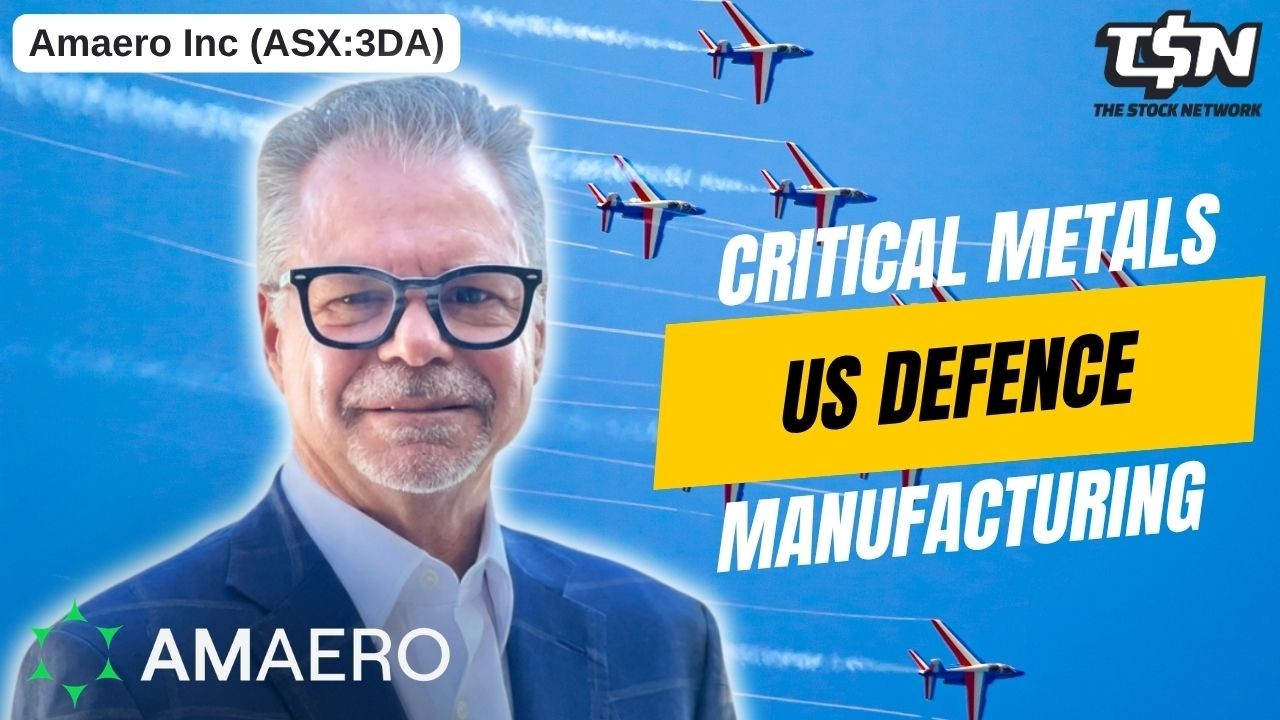
Transcription of The Stock Network Interview with Amaero Inc (ASX:3DA), Chairman & CEO Hank Holland
Lel Smits: Amaero is developing a critical metals alloy power manufacturing facility in Tennessee, USA, targeting high-value powders for mission-critical defense, aerospace, and space applications. Amaero is ramping up production, has also secured a $6.5 million, 13-month U.S. Department of War contract, and also started the current financial year with a backlog 125% above last year. I’m joined today by Chairman and CEO Hank Holland to discuss the company’s U.S. manufacturing opportunity, defense contract production ramp-up, and pathway towards an IPO on the NASDAQ.
Hank, welcome to the Stock Network.
Hank Holland: Thank you, Lel.
Lel Smits: Now, Hank, Amaero is scaling its Tennessee facility for defence and aerospace.
Can you outline for us what you think makes the U.S. market attractive, and also how do you think that this facility will scale?
Hank Holland: Thank you again for the time and the interest. We began this expansion of the investment in our facility three years ago. We announced the relocation to Tennessee July of 2023.
We just completed a $50 million U.S. or about $75 million Australian capital investment plan over three years. That has provided us now with the largest U.S. domestic scale production capacity of titanium powders, as well as refractory powders used in 3D printing, and as you said, quite often for defense applications, as well as space, nuclear energy, things such as that. If you look at the opportunity that we have in the U.S. today, many other companies are just beginning that investment effort, just beginning to scale.
But it is very much a now opportunity with the hard-charging Department of War and trying to production requirements immediately, as opposed to two or three years from now. We think it positions Amaero very uniquely. Now, if we look at winning those defense contracts, you have secured that $6.5 million U.S. Department of War contract.
Lel Smits: Looking at that in more detail, what does this mean for Amaero, and also what could follow on from here?
Hank Holland: So the Department of War contract was a wonderful thing for Amaero. It further, I think, reaffirms our close partnership and the important resource that we are for our country and the Department of War. It is for the development of refractory powders.
As you know, we have the most advanced atomization technology in the world, the IGA premium, that is well suited for IGA, I’m sorry, well suited for refractory powders. So we’re thinking about tantalum, tungsten, niobium, moly, things such as that. And these are particularly important for high temperature applications.
So think about thermal protection systems of defense systems. Think about also propulsion systems of space systems. And so it positions us at that fulcrum of doing development for the Department of War that in turn will go into production.
Just the same, about a month ago, we also announced a contract with BPMI. BPMI is the sole prime defense contractor for naval nuclear, as in naval nuclear submarines. So again, a very important collaboration.
It was in fact the seventh contract that we’ve had with BPMI, albeit the very first that we’ve announced. The first six contracts over the last couple of years we did not announce. We felt it was important to do that work in stealth while we were doing development and qualification work with Bechtel.
Lel Smits: And Hank, finally, your plans to IPO on NASDAQ. You have completed redomiciliation from Australia to U.S. Delaware and also announced plans to IPO on NASDAQ. What is the reasoning for the move to the U.S. and NASDAQ?
Hank Holland: So today we’re a U.S. company, right? We had very loyal support, which we’re very appreciative of ASX shareholders who’ve been on the ASX since we IPOed.
At the very same time today, all of our staff are in the U.S., all of our facilities are in the U.S., all of our productions in the U.S., and all of our customers are in the U.S. And so it made sense, as we announced earlier this year, to complete a redomicillation from Australia to Delaware to complete a PCAOB audit, which is required for a listing in the U.S. And we recently announced that, in fact, we have confidentially submitted a registration statement with the SEC called an S-1, and that is a precursor document to doing an IPO. Lastly, I would say not only are the end markets and our customers in the U.S., but many of the projects we’re working on are classified. An important consideration of those projects is something called FOCI, or Foreign Ownership Control and Influence.
And so the fact before, as an Australian company, we had a board of seven with two Australian directors as required. We recently announced those two directors have resigned. Today we have a board of five exclusively comprised of U.S. residents.
And again, this is important to satisfy FOCI and other considerations for classified projects for the Department of War.
Lel Smits: Hank, thank you for the update on Amaero and all the best for the transition.
Hank Holland: Thanks again.
Ends